
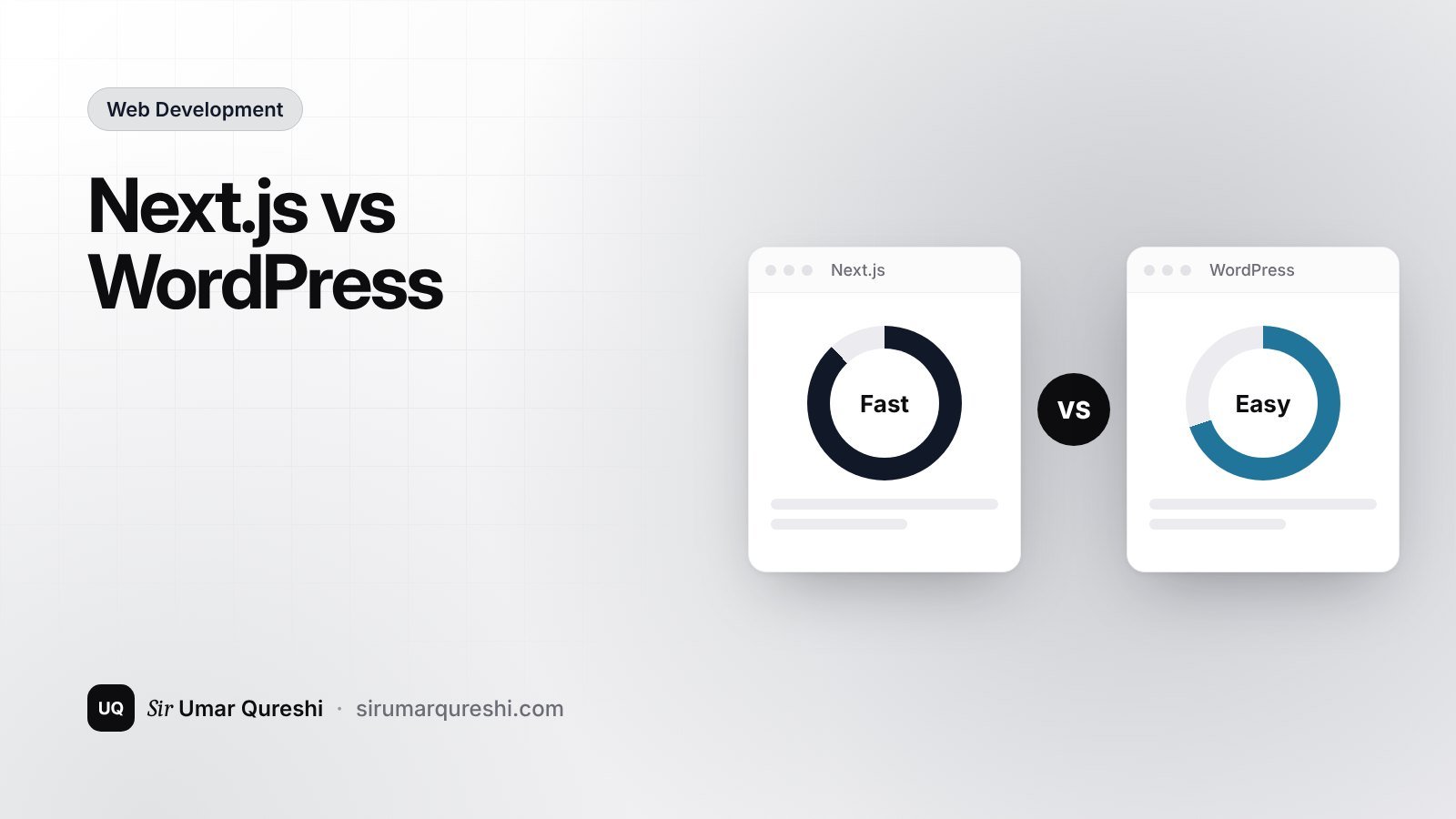
Choose WordPress if you need a content website quickly, on a small budget, and want to manage it yourself with plugins. Choose Next.js if speed, security, custom features and long-term growth matter most — for example a SaaS, a marketplace, a portal or a brand site that must load instantly. Both can rank well on Google when built properly.
Quick comparison
| WordPress | Next.js | |
|---|---|---|
| What it is | A content management system (PHP) | A React framework for web apps and sites |
| Speed | Good with care; plugins can slow it | Excellent — static and server rendering |
| SEO | Strong with SEO plugins | Strong, with full technical control |
| Security | Popular target; needs updates | Smaller attack surface, especially static sites |
| Editing | Built-in admin, very easy | Needs a CMS or admin panel added |
| Custom features | Plugins, or custom PHP | Anything — built as an app |
| Hosting | Any PHP hosting | Static hosting, Node.js or edge platforms |
| Best for | Blogs, brochure sites, small shops | SaaS, marketplaces, portals, premium brand sites |
When WordPress is the better choice
- You need a simple site fast and your budget is limited.
- Your team will publish lots of content and wants a familiar editor.
- Plugins already cover what you need — booking, forms, a small shop.
When Next.js is the better choice
- Performance is a priority — every second of loading costs visitors.
- You need custom features: dashboards, user accounts, payments, integrations.
- The website is part of a product, like a SaaS or marketplace.
- You want a unique design without fighting a theme.
The best of both: Next.js + a simple CMS
Many businesses want Next.js speed with WordPress-style editing. The solution is a Next.js front end with a CMS for content. This very website works that way: the pages are built with Next.js and React for speed and SEO, while the blog runs on a lightweight CMS with an admin panel, team roles and an SEO assistant.
What really decides your SEO
- Helpful, original content that answers real questions.
- Fast loading and a good mobile experience.
- Clean structure: headings, internal links, descriptive URLs.
- Structured data so Google and AI assistants understand your pages — see SEO vs AEO vs GEO.
- Consistent updates over time.
The framework helps, but content and structure decide rankings.
Frequently asked questions
Is Next.js better for SEO than WordPress?
Next.js gives developers more control over performance and technical SEO, but a well-built WordPress site can rank just as well. Content quality matters more than the framework.
Is Next.js more expensive?
Initial development usually costs more because it is custom-built. Over time, lower maintenance, better speed and fewer plugin problems can make it worth it.
Can I edit a Next.js website myself?
Yes, if it is connected to a CMS or admin panel — like the content studio built into this site.
Not sure which is right for you? Tell me about your project and I'll recommend honestly.