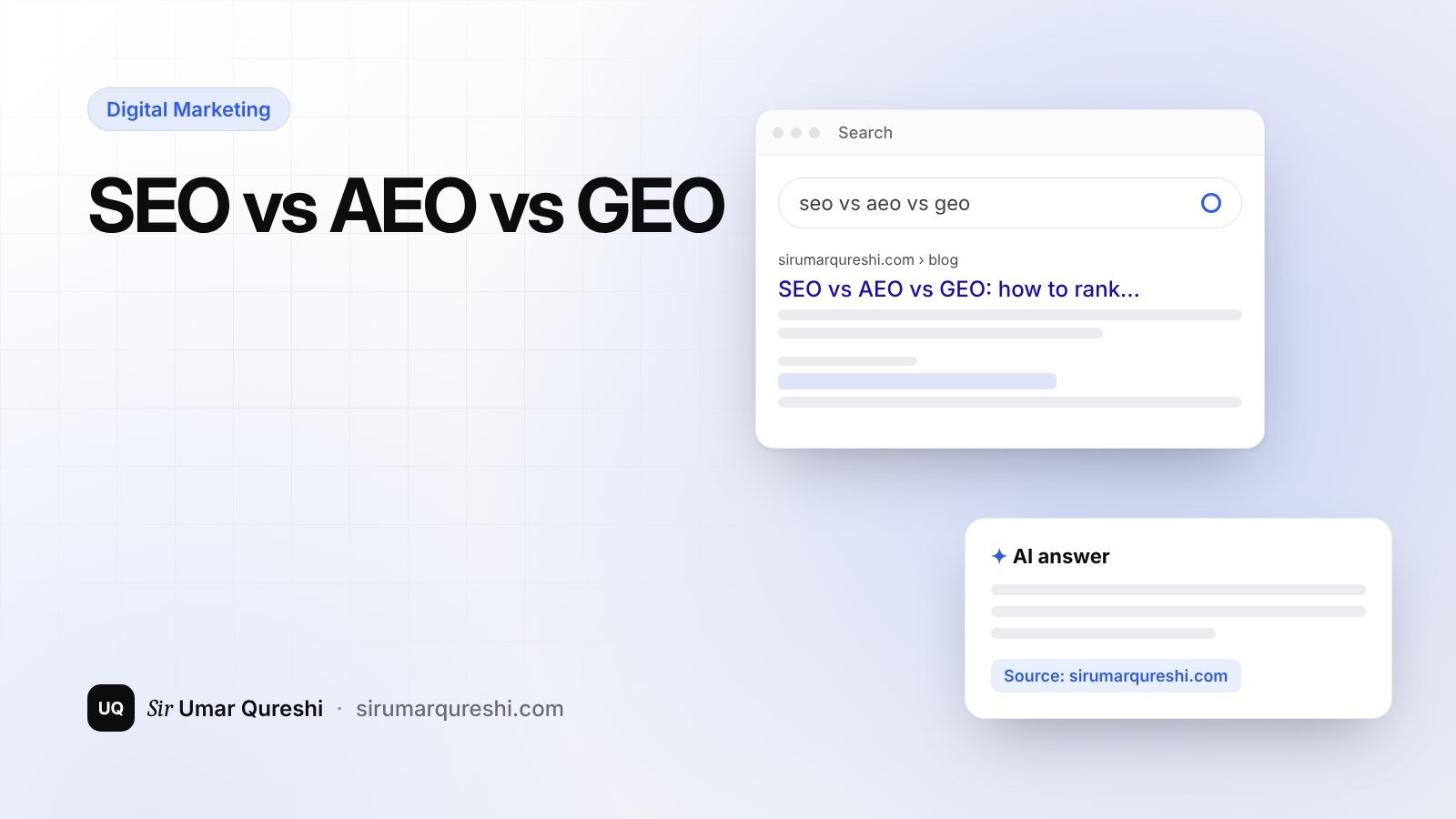
SEO vs AEO vs GEO comes down to where you want to appear. SEO (search engine optimization) gets your page ranked in search results. AEO (answer engine optimization) gets your words chosen as the direct answer in snippets, voice assistants and AI summaries. GEO (generative engine optimization) gets your brand cited and recommended inside AI tools such as ChatGPT, Gemini, Perplexity and Google's AI Overviews.
All three rest on the same foundation: pages that search engines can read, that answer real questions clearly, and that show their evidence.
The difference matters more every month, because people increasingly get answers without clicking. This guide explains each discipline in plain language, shows what Google and OpenAI actually say about AI search, and ends with one checklist you can apply to any website, anywhere in the world.
By the end, you will know:
- What SEO, AEO and GEO each mean, and where they overlap
- What research says about clicks when an AI summary appears
- How AI assistants find and cite web pages
- Whether FAQ schema and other markup still matter in 2026
- A practical checklist to do all three at once
Why Search Changed: Fewer Clicks, More Answers
For twenty years, the goal of search marketing was simple: rank on page one and win the click. AI summaries change that deal. In a study of real browsing behavior, Pew Research Center tracked 900 U.S. adults and analyzed 68,879 of their Google searches from March 2025.
- 18% of those searches produced an AI summary.
- When an AI summary appeared, users clicked a traditional result in 8% of visits. Without a summary, they clicked in 15% of visits.
- Only 1% of visits included a click on a link inside the AI summary itself.
- 26% of searches with an AI summary ended the browsing session, compared with 16% of searches without one.
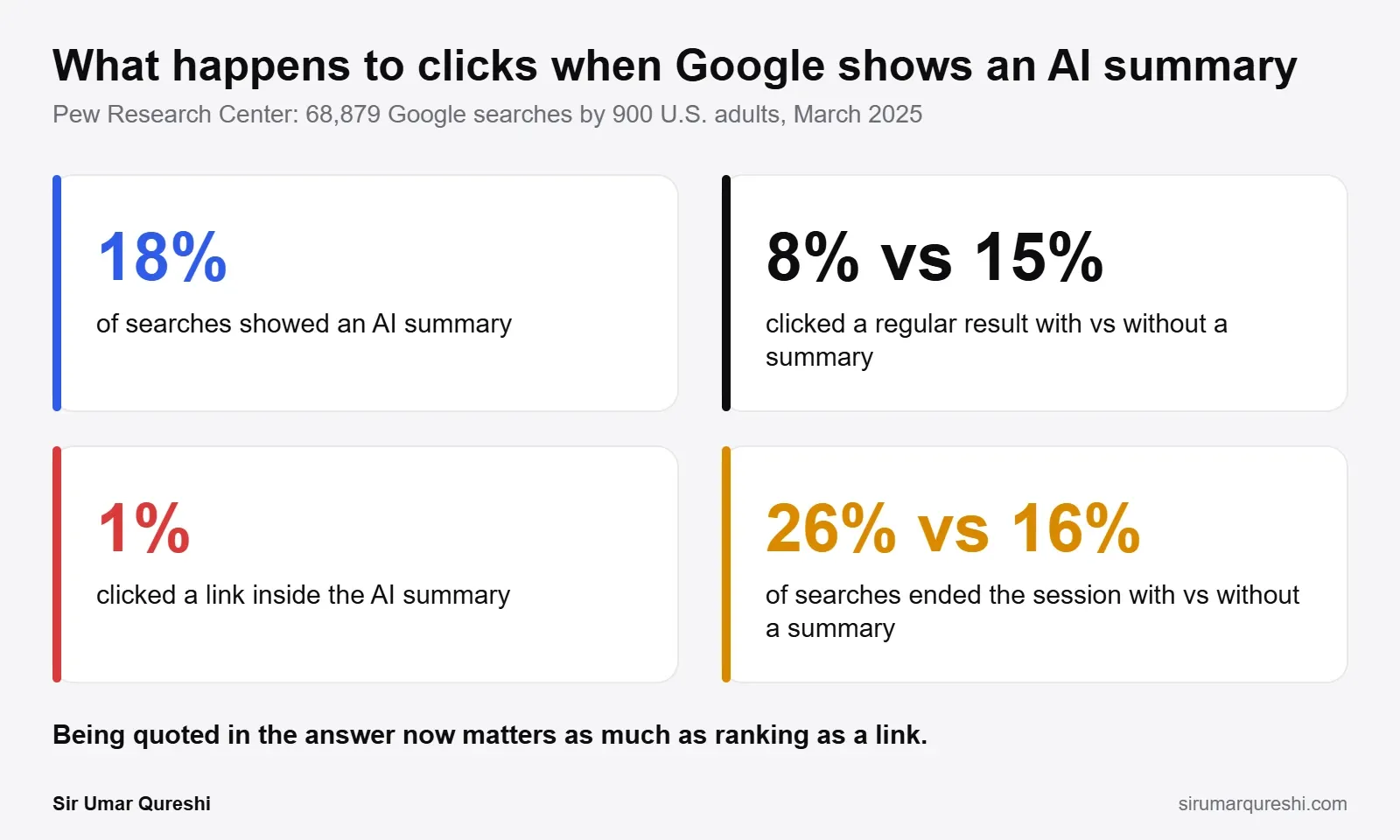
The lesson is not that search is dead. People still search constantly. The lesson is that being the source of the answer now matters as much as being a blue link. If an AI summary quotes your page, your name and expertise reach the reader even when they never click. If it quotes a competitor, they win that reader's trust instead.
What Is SEO?
SEO is the work of making your pages easy for search engines to find, understand and rank. It is still the base layer, because AI features in Google are built on the same index. If your page is not indexed, it cannot be cited.
Good SEO covers five areas:
- Crawling and indexing. Search engines must be allowed to reach your pages, and the pages must load real text, not empty shells that only fill in later.
- Relevance. Each page targets one clear topic and the phrases people actually type, in the title, URL, headings and first paragraph.
- Quality and trust. Content written by someone with real experience, with facts that can be checked and a clear author.
- Links. Links from other trusted sites, and sensible internal links between your own pages.
- Page experience. Fast loading, a layout that works on phones, and no intrusive pop-ups.
The site you are reading now was built with these basics in place from day one. If you are choosing a platform for your own site, my comparison of Next.js and WordPress for business websites explains how the technology affects speed and SEO.
What Is AEO?
Answer engine optimization means structuring content so a search engine or assistant can lift a clean answer from it. The idea started with featured snippets and voice search, and it now applies to AI summaries too.
AEO is mostly about how you write:
- Ask the question in a heading. Use the words a real person would type, such as "How long does it take to learn Python?"
- Answer it in the first one or two sentences below. Be direct. Add detail after the answer, not before it.
- Use lists and tables for steps and comparisons. Machines and humans both scan them easily.
- Define terms clearly. A short, accurate definition is one of the most quoted parts of any page.
- Add a short summary at the top. A two- or three-sentence answer before the long explanation helps readers and answer engines at the same time.
Every post on this blog now opens with a "Quick answer" box for exactly this reason.
What Is GEO?
Generative engine optimization is the newest of the three. The term comes from a research paper, "GEO: Generative Engine Optimization", presented at the KDD 2024 conference by researchers including Pranjal Aggarwal and Karthik Narasimhan. They built a benchmark of 10,000 queries, called GEO-bench, and tested which changes to a web page made generative engines show it more.
Their findings are useful because they are measured, not guessed:
- The best methods could boost a source's visibility in generative engine responses by up to 40%.
- Adding quotations, adding statistics and citing sources were among the strongest methods.
- Keyword stuffing, the old SEO trick, scored below the unchanged baseline.
In plain terms, AI systems favor content that shows evidence. A paragraph that says "many shoppers prefer cash on delivery" is weaker than one that names the source and the number. That is why every factual claim on this blog links to the page it came from.
GEO also includes your wider footprint. Assistants learn about you from many pages, not only your own site. Consistent names, job titles and descriptions across your website, LinkedIn, YouTube and business directories make it easier for an AI system to connect the dots correctly.
SEO vs AEO vs GEO: The Differences at a Glance
| SEO | AEO | GEO | |
|---|---|---|---|
| Main goal | Rank pages in search results | Be the direct answer | Be cited or recommended by AI |
| Where you appear | Classic results lists | Snippets, voice answers, summaries | ChatGPT, Gemini, Perplexity, AI Overviews |
| What wins | Relevance, quality, links, speed | Clear questions and short answers | Evidence, sources, clear entities |
| Main unit | The page | The answer passage | The fact and the brand |
| How you measure it | Rankings, clicks, traffic | Snippet wins, answer presence | Mentions, citations, AI referrals |
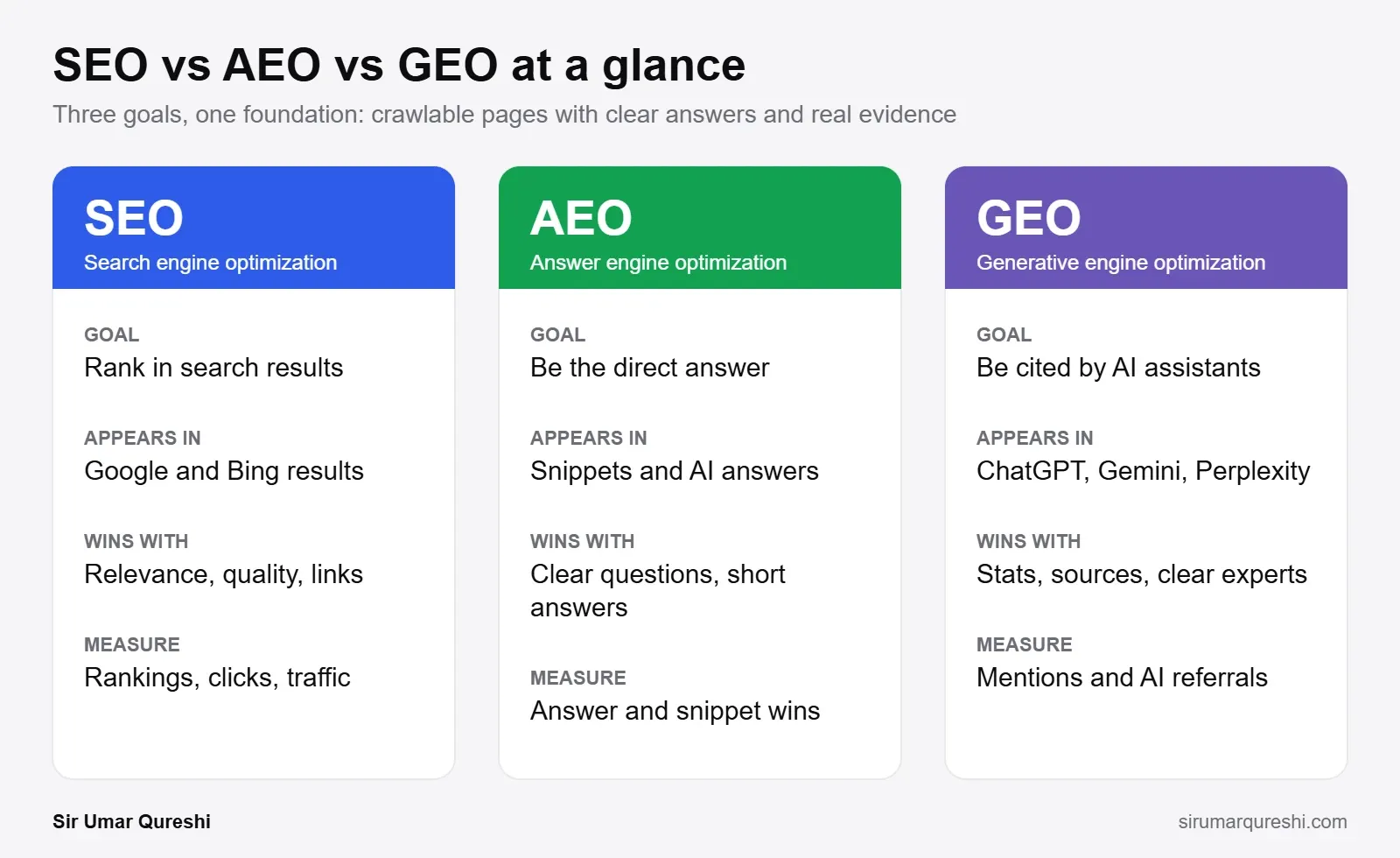
Notice how much they share. A well-structured, evidence-based page that ranks well is also the page most likely to be quoted. You rarely need three separate strategies. You need one strong page that serves all three.
Which One Should You Focus On First?
If your time is limited, the right starting point depends on how customers find businesses like yours.
| Type of business | Start with | Why |
|---|---|---|
| Local service or shop | SEO + business profile | Local searches still lead to calls, visits and map listings |
| Online store | SEO + AEO | Buying guides and clear product answers bring free, ready-to-buy visitors |
| Course, coaching or training | AEO | Students ask specific questions about time, cost and outcomes |
| Consultant, agency or expert brand | GEO | Clients ask AI assistants who to hire, so reputation and citations matter most |
| News or publishing site | All three | You compete on speed, clarity and trust at the same time |
Whichever you start with, the work overlaps. Clear answers help rankings, and rankings help citations. Begin where your customers already are, then extend to the other two.
What Does Google Say About Ranking in AI Overviews?
Google publishes official guidance on this, and it is calmer than most marketing advice. Its page on AI features and your website makes several clear points:
- There are no additional requirements or special optimizations needed to appear in AI Overviews or AI Mode. Normal SEO best practices apply.
- To be shown as a supporting link, a page must be indexed and eligible to appear in Google Search with a snippet.
- You do not need new machine-readable files, AI text files or special schema.org markup to appear in these features.
- Structured data should match the visible text on the page.
- Traffic from AI features is included in Search Console's Performance report under the "Web" search type.
- Site owners can limit what appears with standard controls such as
nosnippet,max-snippetandnoindex.
Be wary of anyone selling a secret AI Overviews hack. Google's own documentation says the path is the same one good SEO has always followed.
How Do ChatGPT and Other AI Assistants Find Your Pages?
AI assistants that search the web send their own crawlers, and you control them in your robots.txt file. OpenAI's crawler documentation separates three bots:
| Bot | What it does | What blocking it means |
|---|---|---|
| OAI-SearchBot | Finds pages for ChatGPT's search features | Your pages will not be shown in ChatGPT search answers |
| GPTBot | Collects content that may train OpenAI's models | Your content should not be used for training |
| ChatGPT-User | Visits a page when a user asks ChatGPT about it | User-initiated, so robots.txt rules may not apply |
The key detail: each setting is independent. Blocking GPTBot to protect your content from training does not remove you from ChatGPT search, but blocking OAI-SearchBot does. Google has a similar split, with Google-Extended controlling use in its AI models separately from normal Search crawling.
Check your robots.txt today. Many sites block AI crawlers by accident through a security plugin or a copied template. On this website, the robots.txt file openly allows the main AI search crawlers, because being cited is the whole point.
A Checklist to Do All Three at Once
Use this list on every important page. It covers SEO, AEO and GEO in one pass.
Foundations
- Make sure the page is indexed. Check it in Google Search Console and Bing Webmaster Tools.
- Allow search and AI search crawlers in robots.txt, including Googlebot, Bingbot and OAI-SearchBot.
- Keep important content in plain HTML text that loads with the page.
- Submit an XML sitemap and keep it current.
Content
- Pick one main question per page and match the words people search for.
- Answer it in the first two sentences, then go deeper.
- Use question-style headings for the follow-up questions.
- Add tables for comparisons and numbered lists for steps.
- Write from real experience, and say who wrote the page and why they know the subject.
Evidence
- Back every number with a link to its original source.
- Add a short sources list at the end of long articles.
- Update facts when they change, and show the "updated" date.
Entity and reputation
- Use the same name, title and description on your site and every profile.
- Add Person or Organization structured data that matches your visible About page.
- Earn mentions on trusted sites in your field: interviews, guest articles, directories and partnerships.
A Worked Example: One Page, Three Ways
Theory is easier to follow with a real page. Take the question "how do I start an online store?" Here is how SEO vs AEO vs GEO shows up on a single guide, using my own article on how to start an online store as the example.
The SEO layer
The page targets one clear phrase, "start an online store," and uses it in the title, the opening sentence, a subheading and the meta description. It links to related posts on the same site and loads fast as plain HTML. None of this is new, and all of it still matters.
The AEO layer
The page opens with a two-sentence answer: the five things you need to start. Each step sits under a clear heading, several headings are phrased as questions, and comparisons live in tables. An answer engine can lift any section without rewriting it.
The GEO layer
Every number in the article links to its source: Census Bureau data for e-commerce share, Etsy's own fee page, the State Bank of Pakistan's payments review and a KPMG tax brief. The author is named, with a real track record of building an e-commerce platform. Those are the signals the GEO research found most useful: statistics, sources and clear expertise.
One page, written once, covers all three. That is the practical goal for every important page on your site.
How Long Does It Take to See Results?
There is no fixed timeline, and anyone who promises one is guessing. What you can expect depends on where your site starts.
- New pages on an established site are usually crawled and indexed quickly, especially if you submit them in Search Console and link to them from other pages.
- A brand-new website takes longer, because search engines and AI systems have little history to trust yet. Consistent publishing and genuine mentions from other sites build that trust.
- Improving an existing page is often the fastest win. Pages that already get impressions can move up once the answer is clearer and the evidence is stronger.
Review your Search Console data monthly rather than daily. Ranking and citation patterns settle over weeks, not hours.
How Do You Measure Success When Fewer People Click?
Traffic alone no longer tells the whole story. Track a wider set of signals:
- Search Console impressions and clicks. Rising impressions with flat clicks often means you are being seen in summaries.
- Branded searches. More people searching your name or business name is a strong sign that answers mention you.
- AI referrals. In your analytics, look for visits from chatgpt.com, perplexity.ai and gemini.google.com.
- Conversions, not just visits. Google says clicks from AI Overviews tend to be higher quality, so measure enquiries, sign-ups and sales.
- Manual checks. Once a month, ask the main assistants the questions your customers ask, and note who gets cited.
Common Mistakes That Hurt All Three
- Keyword stuffing. The GEO research found it performs worse than doing nothing.
- Mass-produced, unedited AI text. Thin pages with no experience or sources rarely rank and are rarely cited.
- Claims without sources. Unsupported numbers make a page less trustworthy for readers and machines.
- Accidentally blocking crawlers. One wrong robots.txt line can remove you from search or AI answers.
- Markup that does not match the page. Google's guidance is clear that structured data should reflect visible content.
- Chasing every new acronym. Strong pages, clear answers and real evidence work across all of them.
What This Means for Businesses in Pakistan
For a business in Pakistan, these changes are an opening, not a threat. Many local categories, from training institutes to online stores, still have few pages that answer questions clearly, cite real data and name a real expert. That gap is an opportunity for anyone willing to write properly.
- Write in clear English for global reach, and consider separate pages for Urdu-language searches where your customers use them.
- Keep your Google Business Profile complete and consistent with your website, since local answers often draw on it.
- Answer the exact questions customers ask on WhatsApp and the phone, and publish those answers as pages.
- Cite Pakistani sources, such as the State Bank, PTA and official government pages, when you mention local numbers.
- List your business on the directories and marketplaces your customers already trust, and keep your phone number, address and business name identical everywhere.
- Publish case studies of real work with real results you can show. A specific project page is far more convincing to people and machines than a list of services.
If you sell online, my guide on how to start an online store shows how buying guides and comparison pages bring free search traffic over time. Small businesses can also use AI automation to turn customer questions into content faster.
One Thing to Do This Week
You do not need to choose between SEO vs AEO vs GEO. Pick the one page that matters most to your business. Rewrite its opening so the main question is answered in two sentences, add a source link for every number on the page, and check that your robots.txt allows OAI-SearchBot and Googlebot. That single page, done well, will serve SEO, AEO and GEO together.
If you want a website built to be found in search and cited by AI from the start, see my services or read more about my digital marketing, SEO, AEO and GEO work.