AI assistants like ChatGPT, Gemini and Claude are best used as a tutor, a planning partner and a feedback tool — not as a machine that does the work for you. Used well, they save teachers hours every week and help students understand difficult topics faster. Used badly, they produce copied homework and confident mistakes.
What AI assistants are good at — and where they fail
| Good at | Be careful with |
|---|---|
| Explaining a concept in simpler words | Facts, dates and statistics — verify them |
| Generating examples and practice questions | Very recent events |
| Giving feedback on writing and code | Complex maths without checking each step |
| Summarising long text | Anything private: student data, exam papers |
| Brainstorming lesson ideas | Citations — they can be invented |
For teachers: five ways to save hours every week
- Lesson plans: ask for a 40-minute plan with objectives, an activity and an exit question — then adapt it to your class.
- Differentiated material: the same topic explained at three levels for weaker, average and advanced students.
- Question banks: MCQs with answer keys and common wrong answers explained.
- Feedback drafts: paste a (de-identified) student answer and a rubric, get a first draft of feedback, then personalise it.
- Parent communication: clear, polite messages in English or Urdu.
A prompt template teachers can copy
Act as an experienced teacher. Create a 40-minute lesson on [topic] for [grade/level] students in Pakistan. Include: learning objectives, a 5-minute warm-up, one hands-on activity, three check-for-understanding questions with answers, and homework.
For students: learn faster without cheating
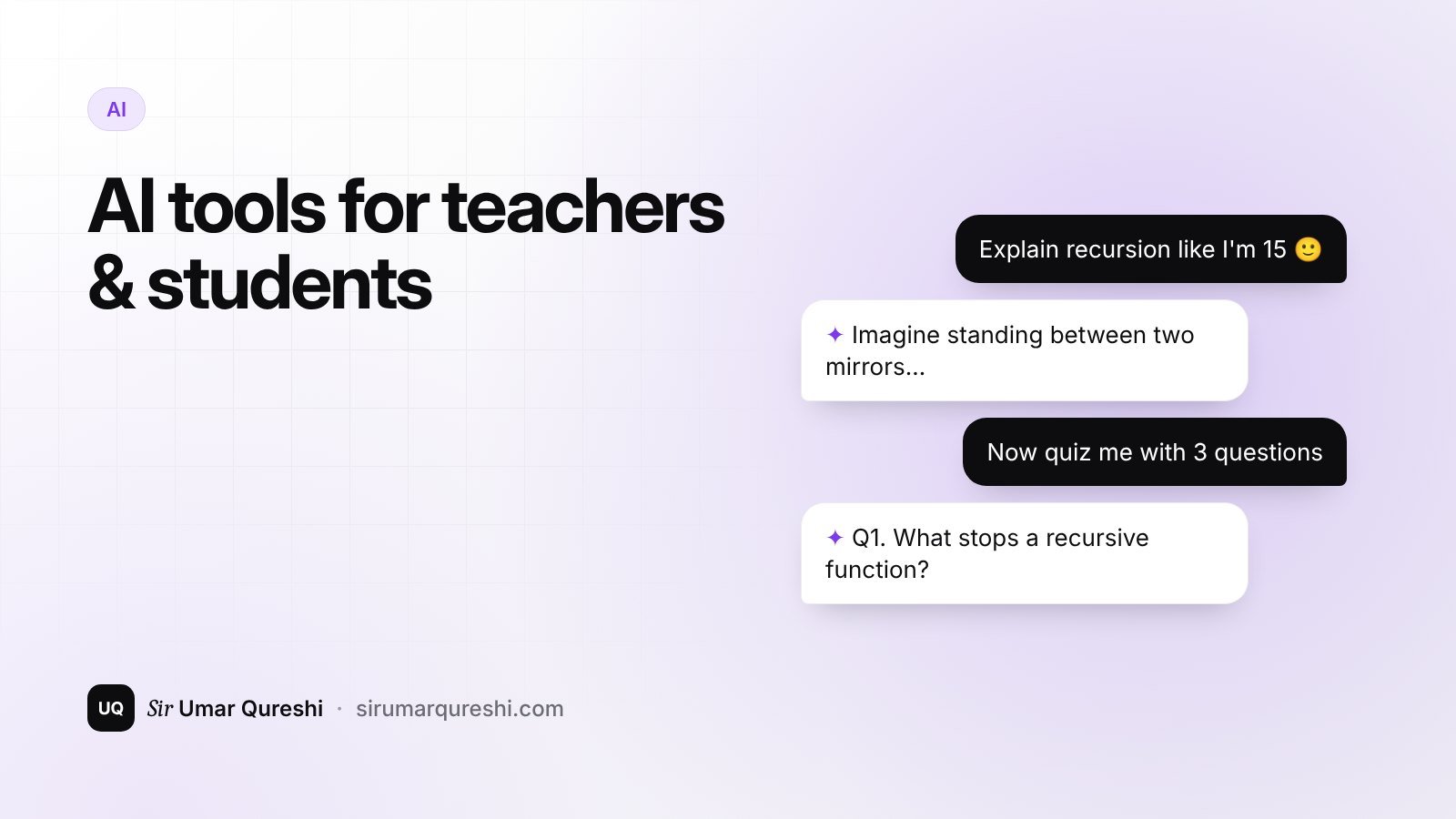
- Ask it to explain, not to answer: "Explain recursion like I'm 15, then give me one exercise."
- After reading a chapter, ask it to quiz you and to correct your answers.
- Paste your code error and ask why it happened before asking for the fix.
- Use it to plan your study timetable before exams.
- Always rewrite in your own words — if you can't explain it, you haven't learned it.
💡 Tip: A simple honesty rule for students: if you would be embarrassed to show your teacher the chat, don't submit the work.
Rules every school and academy should set
- Say clearly which assignments allow AI help and which do not.
- Require students to disclose AI use and attach the prompts they used.
- Assess the process — drafts, oral explanations, in-class work — not only the final file.
- Never paste students' personal data or confidential exam papers into AI tools.
- Teach students to verify facts and cite real sources.
Which tool should you use?
ChatGPT, Gemini and Claude are all capable general assistants, and each has free and paid options. The best choice is the one your school allows and you learn to use well — prompting skill matters far more than the brand. Features and pricing change quickly, so check each provider's current plans.
Frequently asked questions
Is using ChatGPT for homework cheating?
It depends on your teacher's rules. Using AI to understand a topic is learning; submitting AI-written work as your own when it isn't allowed is cheating.
Will AI replace teachers?
No. AI can explain and generate material, but motivation, mentoring, judgement and human connection are what make students succeed — and that is a teacher's job.
I run AI workshops for teachers and students — see AI & machine learning.