Yes, you can learn Python's fundamentals in 30 days if you practise about one to two hours every day and build small projects as you go. You won't be an expert in a month, but you will be able to write useful programs, automate simple tasks and start learning data science or web development with confidence.
Before day 1: set up properly
- Install the latest Python 3 from python.org (tick "Add Python to PATH" on Windows).
- Install VS Code and the Python extension — or use a free online notebook to start instantly.
- Create one folder called python-30-days and save every exercise there.
Week 1 — The foundations (days 1–7)
| Day | Learn | Practice task |
|---|---|---|
| 1 | print(), comments, running a file | Print your name, city and a fun fact |
| 2 | Variables & data types | Store and print details of three students |
| 3 | Input & type conversion | Ask for two numbers and print their sum |
| 4 | Operators & f-strings | Build a bill calculator with 10% tax |
| 5 | if / elif / else | Grade calculator (A, B, C, Fail) |
| 6 | while loops | Number guessing game |
| 7 | Review + mini-project | Project 1: a simple ATM menu |
Week 2 — Working with data (days 8–14)
| Day | Learn | Practice task |
|---|---|---|
| 8 | for loops & range() | Print multiplication tables |
| 9 | Lists | Store marks and find highest, lowest, average |
| 10 | List methods & slicing | Manage a shopping list |
| 11 | Tuples & sets | Find unique cities from a list |
| 12 | Dictionaries | Phone book: add, search, delete |
| 13 | Nested data | List of student dictionaries |
| 14 | Review + mini-project | Project 2: student result system |
Week 3 — Writing real programs (days 15–21)
| Day | Learn | Practice task |
|---|---|---|
| 15 | Functions & parameters | Reusable area/volume functions |
| 16 | Return values & scope | Temperature converter module |
| 17 | Modules (math, random, datetime) | Random password generator |
| 18 | Reading & writing files | Save the phone book to a .txt file |
| 19 | CSV files | Read a CSV of sales and print totals |
| 20 | Errors & try/except | Make your calculator crash-proof |
| 21 | Review | Refactor old exercises into functions |
Week 4 — Level up (days 22–30)
| Day | Learn | Practice task |
|---|---|---|
| 22 | Classes & objects (basics) | A BankAccount class |
| 23 | pip & virtual environments | Install your first package |
| 24 | Requests & APIs | Fetch weather or exchange-rate data |
| 25 | Intro to Pandas | Load a CSV and summarise it |
| 26 | Simple charts (Matplotlib) | Plot monthly sales |
| 27–29 | Final project | Project 3: expense tracker with CSV + chart |
| 30 | Publish | Put all three projects on GitHub with a README |
Rules that make the plan work
- Type the code yourself — never copy-paste while learning.
- When you get an error, read it slowly; the last line usually tells you what is wrong.
- Use AI assistants to explain errors, not to write your homework.
- If you miss a day, continue — don't restart.
What to learn after 30 days
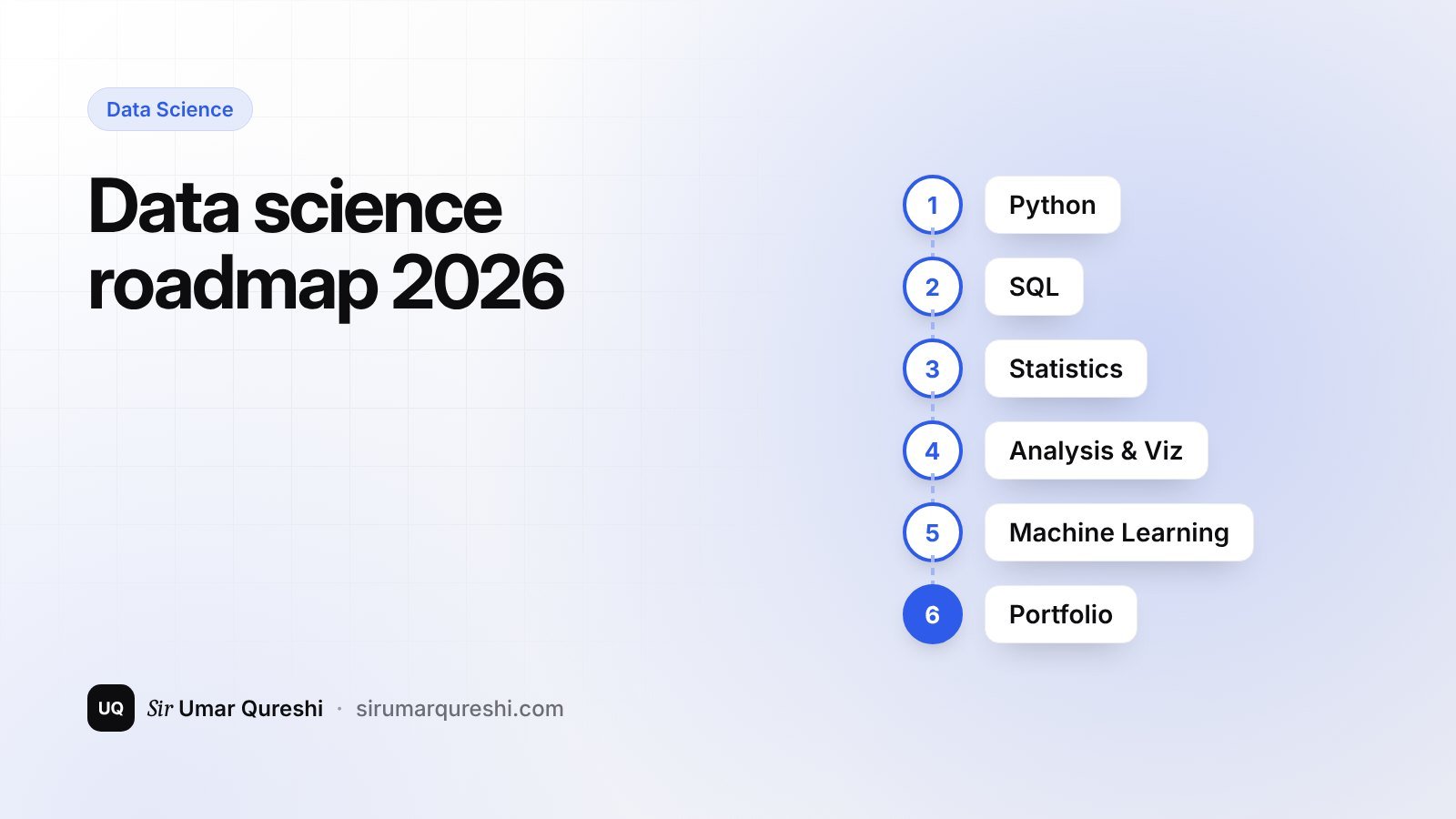
- Data science: Pandas, NumPy, statistics and machine learning — see my data science roadmap.
- Web development: Flask or Django, then databases.
- Automation: Excel automation with openpyxl, web scraping, scheduled scripts.
Frequently asked questions
Can I learn Python without a computer science background?
Absolutely. Python is designed to be readable, and most of my beginner students have no programming background.
Is Python enough to get a job?
Python plus one specialisation — data analysis, web development or automation — and a portfolio of projects is a strong combination for internships and freelance work.
Prefer learning with a teacher? Join a Python & data science class.