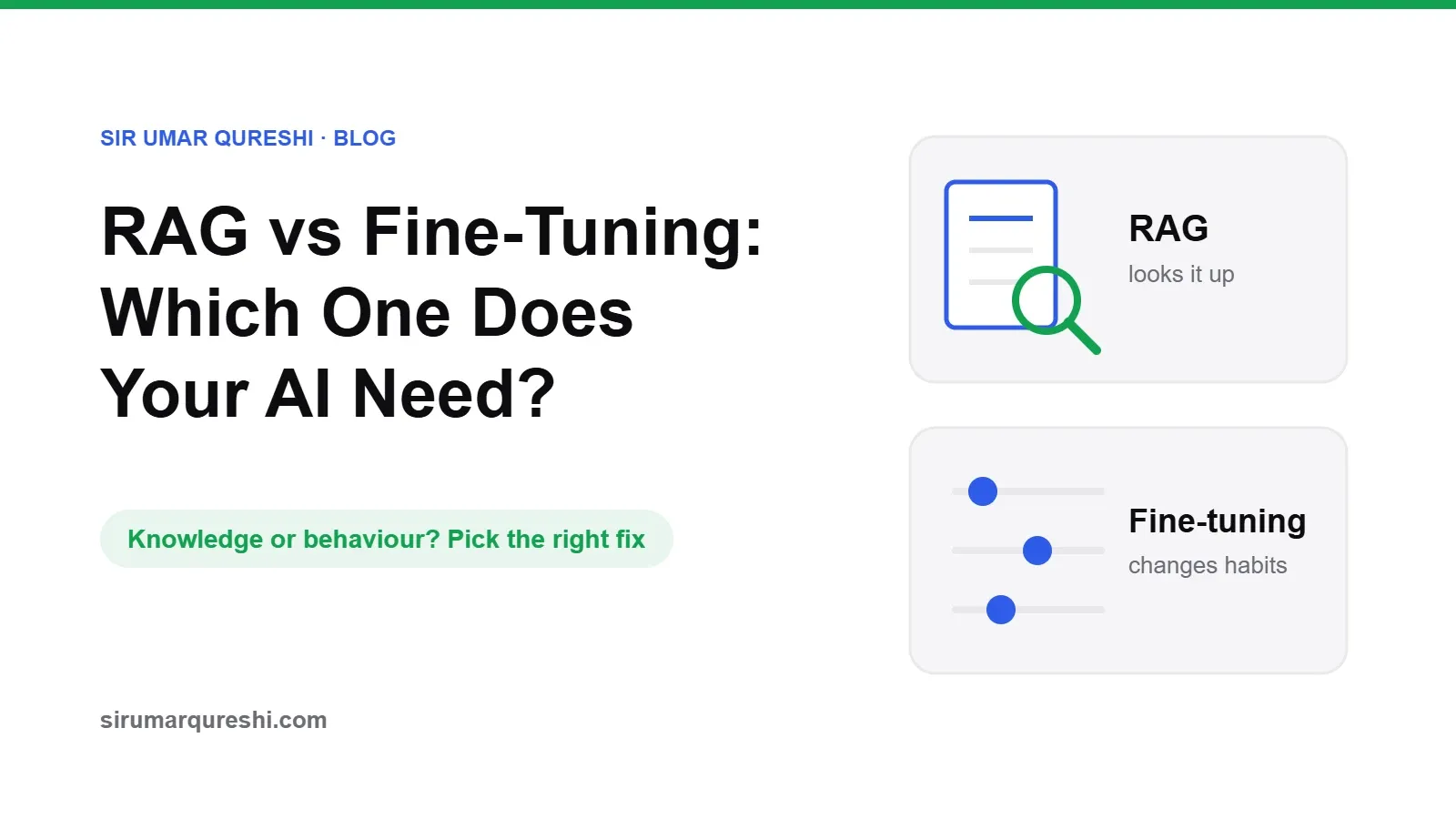
RAG vs fine-tuning comes down to one question: does your AI need new knowledge, or a new behaviour? Retrieval-augmented generation (RAG) looks up your documents at the moment someone asks a question, so it is the right choice for facts that change. Fine-tuning retrains the model on examples, so it suits a fixed style, format or narrow task. For most business chatbots in 2026, start with RAG or a well-built prompt, and only fine-tune when testing proves you need it.
I get this question from students and from business owners almost every week. One wants a chatbot that knows their school's fee policy. Another wants an assistant that writes product descriptions in their brand voice. They have usually read that they must "train their own AI", and they are ready to spend money on GPUs. In most cases they don't need to. This guide compares the two approaches side by side, shows what changed this year, and walks through a realistic example so you can pick the cheaper path with confidence.
What Is the Difference Between RAG and Fine-Tuning?
A large language model (LLM) learns from a huge pile of text during training. After that, its knowledge is frozen. It knows nothing about your price list, your exam timetable or the policy you changed last Tuesday. There are two main ways to fix that gap.
Retrieval-augmented generation leaves the model as it is. When a user asks something, your app first searches your own documents, picks the few passages that match, and pastes them into the prompt. The model then writes an answer using that text. The term comes from a 2020 research paper by Patrick Lewis and colleagues, which paired a language model with a searchable index of Wikipedia. The authors reported that this mix produced more specific and more factual text than a model working from memory alone.
Fine-tuning changes the model itself. You show it dozens or hundreds of example conversations, each with the ideal answer, and a training run nudges its internal weights. Afterwards the model behaves differently even with a short prompt. IBM's explainer describes it as retraining a pretrained model on a smaller, focused, labelled dataset so it adapts to a domain.
A simple way to remember it:
- RAG is an open-book exam. The student is the same, but they can check the textbook before answering.
- Fine-tuning is extra coaching. The student practises one type of question until the answer style becomes a habit.
Coaching does not put next month's fee schedule into anyone's head. That is why so many fine-tuning projects disappoint. People use it to add facts, when it is far better at shaping behaviour.
How Does Retrieval-Augmented Generation Work?
You don't need a research team to build a basic RAG system. You need a few moving parts and some patience with your data. Here is the flow I teach in class:
- Collect your documents. PDFs, Word files, web pages, a spreadsheet of FAQs. Clean out old versions first, because the system will happily quote outdated text.
- Split them into chunks. Break each document into short passages of a few hundred words. Small chunks make search more precise.
- Turn each chunk into an embedding. An embedding model converts text into a list of numbers that captures its meaning. Similar ideas end up with similar numbers.
- Store the embeddings in a vector database. This is a database built to find the "closest" chunks to a query quickly. Options range from a Postgres extension to a hosted service.
- Search at question time. When a user types a question, you embed the question too and fetch the top matching chunks.
- Build the prompt and answer. Put the retrieved chunks into the prompt with an instruction such as "answer only from these sources and cite them", then send it to the model.
The embedding step is cheaper than most people expect. OpenAI lists its text-embedding-3-small model at $0.02 per million input tokens. If your whole document collection comes to five million tokens, embedding it once costs about ten US cents at that rate. The bigger cost is your time: cleaning files, testing answers and keeping the index up to date.
Why retrieval quality matters more than the model
If search brings back the wrong passage, even the best model will give a confident wrong answer. Anthropic's engineering team tested this in their contextual retrieval write-up from September 2024. Adding a short summary of context to each chunk before embedding cut failed retrievals by 35%. Combining that with keyword search (BM25) cut them by 49%, and adding a reranking step brought the reduction to 67%. The lesson for beginners is clear: spend your early effort on search, not on switching models.
How Does Fine-Tuning an LLM Work?
When you fine-tune an LLM, you prepare a training file of example conversations. Each example has an input and the exact output you want. The provider, or your own GPU, trains a new version of the model on that file. You then call your custom model instead of the base one.
OpenAI's supervised fine-tuning guide gives useful numbers even if you use another platform. It requires at least 10 examples, says improvements usually show with 50 to 100, and recommends starting with 50 well-made examples and then measuring. If 50 examples change nothing, the guide suggests rethinking the task or the prompt before adding more data. It also lists the jobs fine-tuning suits best:
- classification, such as sorting support tickets into categories
- nuanced translation
- producing content in a specific, consistent format
- fixing cases where the model keeps ignoring instructions
Notice what is missing from that list: "teach the model my company's facts". The same guide puts evaluation first. Its advice is to set up tests ("evals") before you spend on training, so you can prove the tuned model is better.
LoRA and QLoRA: fine-tuning on smaller hardware
Full fine-tuning updates every weight in the model, which is why IBM notes it can need several powerful GPUs. Parameter-efficient methods changed that. The LoRA paper by Edward Hu and colleagues (2021) showed that training small add-on matrices could cut trainable parameters by 10,000 times and GPU memory needs by about three times, compared with fully fine-tuning GPT-3 175B. Two years later, the QLoRA paper by Tim Dettmers and colleagues fine-tuned a 65-billion-parameter model on a single 48 GB GPU by combining LoRA with a compressed (quantized) base model.
For you, this means LoRA and QLoRA fine-tuning of open models is now realistic on rented cloud GPUs or a strong workstation. If you have already tried running LLMs locally with Ollama or LM Studio, a LoRA adapter is the natural next experiment.
RAG vs Fine-Tuning: The Side-by-Side Comparison
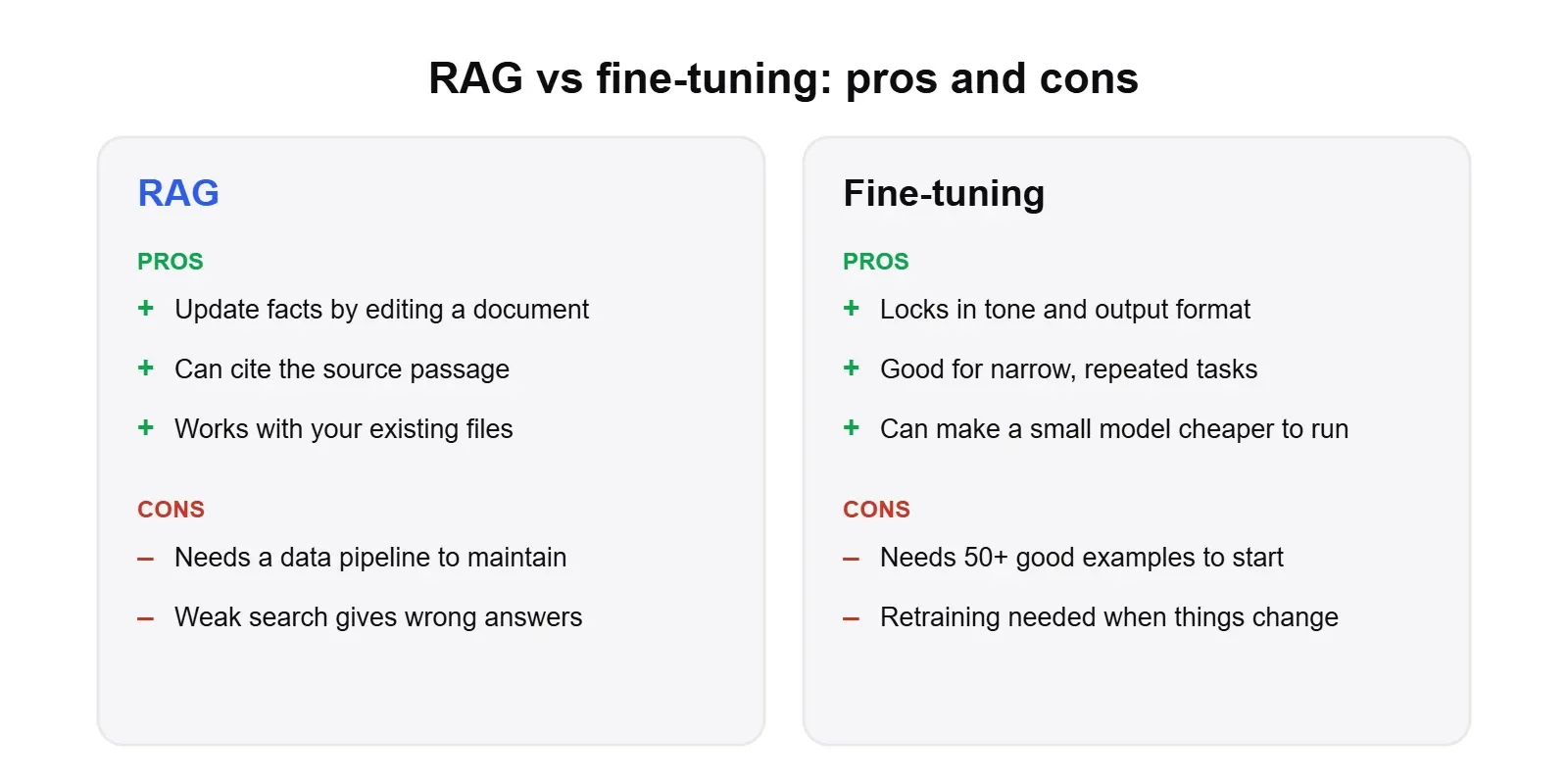
In the RAG vs fine-tuning decision, here is how the two approaches compare on the points that matter when you are spending real money and time.
| Question | RAG | Fine-tuning |
|---|---|---|
| What does it change? | What the model can read at answer time | How the model behaves by default |
| Best for | Facts, policies, prices, documents that change | Tone, format, classification, narrow repeated tasks |
| Updating information | Edit the document and re-index it, often in minutes | Prepare new examples and run training again |
| Can it cite sources? | Yes, it can show which passage it used | No, the knowledge is blended into the weights |
| Data you need | Your existing documents, cleaned | At least 50 good input and output pairs to start |
| Main hidden cost | Building and maintaining the data pipeline | Preparing examples, training runs and re-testing |
| Main risk | Poor search returns the wrong passage | Model learns bad habits from weak examples |
| Skills required | Python, APIs, basic databases | All of that plus dataset design and evaluation |
IBM's comparison makes a similar point about effort. RAG needs data pipelines and careful protection of personal data. Fine-tuning needs compute and a well-labelled dataset. Neither is free. They simply put the work in different places.
What Changed in 2026? OpenAI Is Winding Down Self-Serve Fine-Tuning
This is the update most older articles miss. On 7 May 2026, OpenAI announced on its deprecations page that it is phasing out self-serve fine-tuning. The timeline is:
- 7 May 2026: organisations that had never run fine-tuning could no longer create fine-tuning jobs.
- 2 July 2026: organisations that had not used a fine-tuned model in the past 60 days lost the ability to create new jobs.
- 6 January 2027: active existing customers can no longer create new fine-tuning jobs. Existing fine-tuned models keep working until their base model is retired.
According to Tessl's coverage of the notice, OpenAI's stated reason is that newer base models follow instructions and formats much better, so fewer tasks need a custom model. The same report notes that Google's Gemini on Vertex AI and Anthropic's Claude on Amazon Bedrock still offer managed fine-tuning, and that open-source models with LoRA or QLoRA remain an option.
So if you are a new developer in Pakistan opening an OpenAI account today, fine-tuning a GPT model is simply not available to you there. That pushes the default even further towards RAG and good prompting, with open-model fine-tuning kept for special cases.
Note: Platform rules change fast. Before you plan a fine-tuning project on any provider, open that provider's current documentation and confirm which models can be tuned and whether your account is eligible.
When Should You Use RAG?
Choose RAG when the main problem is "the model doesn't know our information". Typical signs:
- Your facts change. Prices, stock, admission dates, timetables and policies are updated every month or every term.
- You need answers with sources. A student, customer or manager wants to see which page the answer came from.
- You have lots of documents. Manuals, past circulars, course outlines or a product catalogue that no prompt could hold.
- Different users may see different data. RAG lets you filter search by user or department, so a student never sees staff-only files.
This is the pattern behind most of the useful AI automation for small businesses: a help-desk bot over the FAQ, an internal assistant over HR policies, or a search box over years of reports. An AI chatbot for business is almost always a RAG project first.
When Is Fine-Tuning the Better Choice?
Fine-tuning earns its cost when the problem is "the model knows enough, but it doesn't behave the way we need, every single time". Good signs include:
- A strict output format. You need the same JSON structure or report layout thousands of times, and prompting still slips.
- A narrow classification job. Sorting messages into 12 categories, tagging sentiment, or routing tickets.
- A distinct voice. A brand or publication with a style that is hard to describe in a prompt but easy to show with examples.
- A smaller, cheaper model. OpenAI's guide describes "distillation": get a large model working well with a prompt, save its answers, then train a smaller model on them so it is faster and cheaper to run.
Even then, many teams combine the two. A fine-tuned model can handle the format and tone, while RAG supplies the current facts. If you only remember one rule, make it this: fine-tune for how it answers, retrieve for what it knows.
The Option Most People Skip: Put It All in the Prompt
Before you build either system, check whether you need one. Modern models accept very long prompts. Anthropic's retrieval article states that if your knowledge base is smaller than about 200,000 tokens, you can often place all of it in the prompt and skip RAG. It adds that prompt caching can make this more than twice as fast and up to 90% cheaper on repeated calls.
For a small school, clinic or shop, the full FAQ, fee list and policy page may fit comfortably within that limit. In that case, a carefully written system prompt is the fastest way to a working prototype. Good prompt engineering is still the first skill to learn. It is also the baseline you will compare every RAG or fine-tuning experiment against.
Here is the order I recommend to every learner:
- Write a strong prompt with clear rules and a few examples.
- If the information is too big or changes often, add RAG.
- If the behaviour is still unreliable after that, test fine-tuning on a small scale.
A Worked Example: A Help-Desk Bot for an Online Academy
This is an illustrative scenario, not a real client project. Imagine an online academy, similar in spirit to the PSTA academy platform I built, that wants a chatbot on its website. Parents and students keep asking the same things: course fees, batch start dates, how to get a certificate, and what to do if a payment fails.
Step 1: Measure the knowledge
The team gathers the FAQ page, the fee schedule, the refund policy and the course outlines. Together they come to well under 200,000 tokens. That means the first version can be a single prompt with all of it pasted in.
Step 2: Watch where it breaks
After a month, two problems appear. The academy now publishes a new batch schedule every two weeks, and someone forgets to update the prompt. It also adds 40 recorded lessons with transcripts, which pushes the content past a comfortable prompt size.
Step 3: Move to RAG
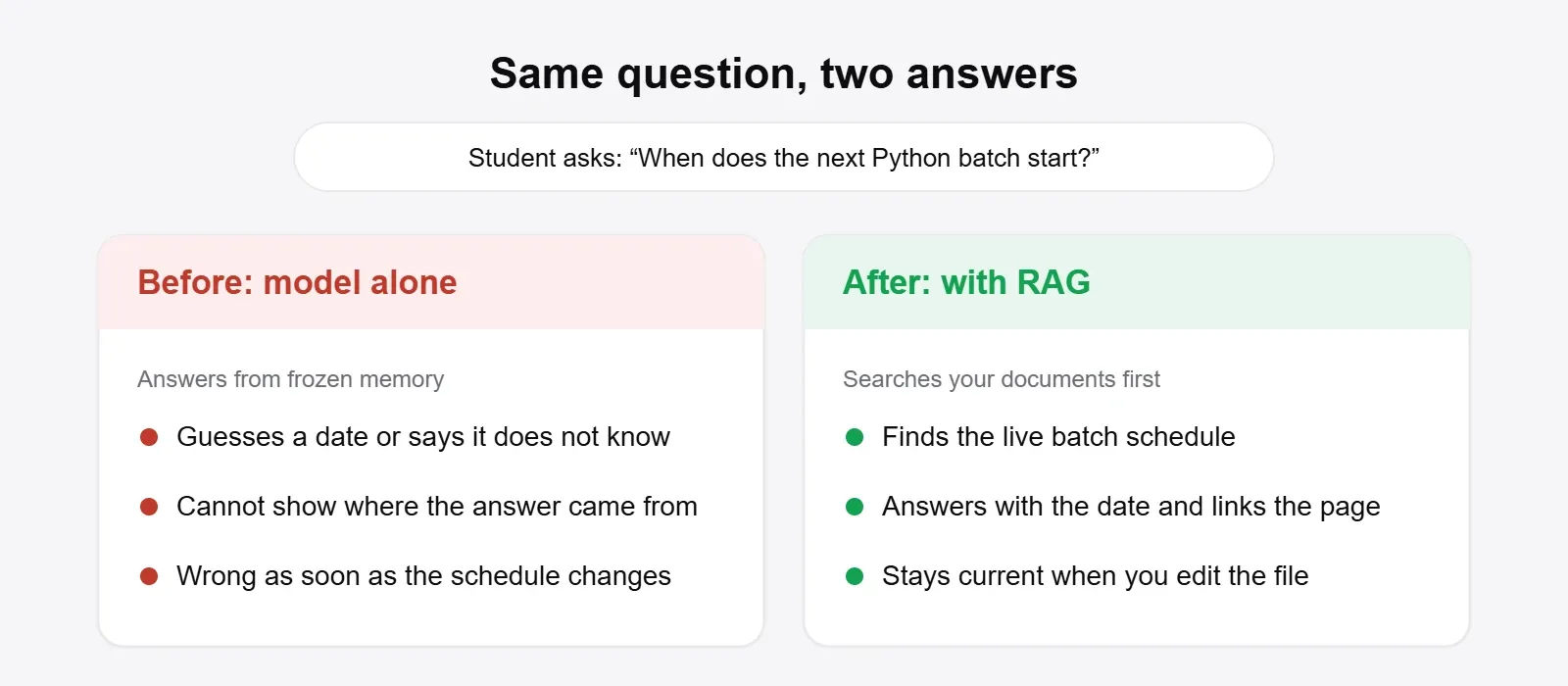
The developer stores every document in a vector database, re-indexes automatically whenever the admin panel saves a change, and tells the model to cite the page it used. Now the bot answers "When does the next Python batch start?" from the live schedule, with a link.
Step 4: Decide whether to fine-tune
The academy also wants the bot to sort every message into "fees", "technical", "admissions" or "complaint" for staff. A prompt handles this well at first, but after reviewing 300 conversations the team finds it is wrong too often on mixed messages. That narrow, repeated classification task is the one part worth testing with fine-tuning, starting with 50 to 100 labelled examples.
Notice the pattern, because it settles most RAG vs fine-tuning debates. The facts went into RAG. Only the repeated behaviour was a fine-tuning candidate. Most real projects follow this same shape.
RAG vs Fine-Tuning: Five Questions to Decide
When a client asks me about RAG vs fine-tuning, I don't start with technology. I ask these five questions, in this order, and the answers usually make the choice for us.
- Does the model already answer well with a good prompt? If yes, stop. You may not need either method.
- Is the problem missing knowledge or wrong behaviour? Missing knowledge points to RAG. Wrong format, tone or labels point to fine-tuning.
- How often does the information change? Weekly or monthly changes make retrieval the only sensible option, because retraining every time is slow.
- Do users need to see sources? If trust matters, as it does with fees, policies or medical and legal text, RAG lets you show the passage behind each answer.
- Do you have at least 50 high-quality examples and a test set? If not, you are not ready to fine-tune yet. Build the examples first, using real conversations.
If you answered "knowledge", "often" and "yes, sources", you have your answer. If you answered "behaviour" and you already have clean examples, a small fine-tuning test is worth a try.
Common Mistakes When Choosing Between RAG and Fine-Tuning
These are the errors I see most often when students and clients start their first AI project.
- Fine-tuning to add facts. The model may repeat training answers word for word but still fail on a slightly different question. It also can't tell you where the fact came from.
- Skipping evaluation. Write 30 to 50 real test questions with correct answers before you build anything. Without them, "it feels better" is the only measure you have.
- Feeding RAG messy files. Duplicate PDFs, scanned images without text and three versions of the same policy will confuse search. Clean data beats a bigger model.
- Chunks that lose context. A passage that says "the fee is Rs 5,000" without naming the course is useless on its own. Add a heading or short summary to each chunk, as Anthropic's tests suggest.
- Ignoring privacy. Don't index CNIC numbers, phone numbers or student marks unless you have strong access controls. IBM's article stresses data protection for exactly this reason.
- Building on a platform that is closing. Check the provider's deprecations page first, as the OpenAI change shows.
Tip: Keep a simple spreadsheet of test questions, the expected answer and the bot's actual answer. Run it after every change. It takes ten minutes and saves weeks of guessing.
Which Skills Do You Need for Each Path?
If you are a student in Pakistan wondering what to learn, the good news is that RAG uses skills you can build in a few months. You need comfortable Python, which my 30-day Python plan covers, plus working with APIs, JSON and a database. Understanding embeddings and basic search ranking comes next.
Fine-tuning asks for more. On top of the RAG skills, you need to design datasets, split training and test data, read evaluation results and manage GPU costs. That is closer to the later stages of a data science roadmap. My advice is to build two or three RAG projects first. Fine-tuning will make much more sense once you have seen where retrieval and prompting fall short.
For a portfolio, a small RAG app over your college prospectus or a local business's FAQ is a strong project. It shows employers and clients that you can turn messy documents into a useful tool, which is the kind of work businesses actually pay for.
Your Next Step This Week
Pick one real set of documents you know well, such as your school's handbook or a shop's FAQ. Count roughly how big it is, write 20 test questions, and try the "all in the prompt" method first. If the answers are good, you have a working assistant. If they are not, you now know exactly why, and you can settle RAG vs fine-tuning with evidence instead of guesses.
If you would like help building a RAG chatbot or an AI feature for your business, see my development services or get in touch. If you want to learn to build these yourself, my teaching page explains how I run classes.