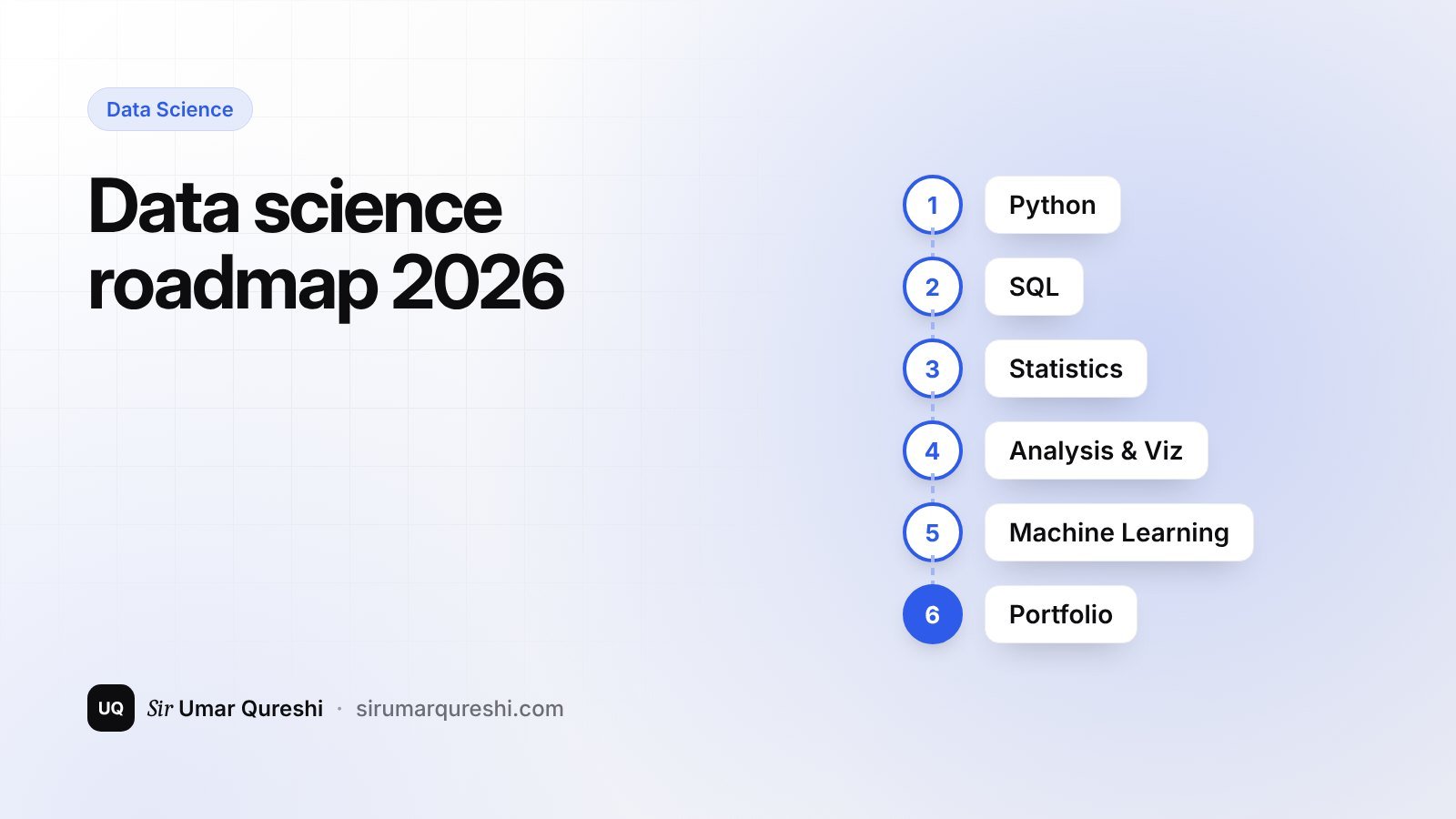
The fastest path into data science is: Python → SQL → statistics → data analysis and visualisation → machine learning → portfolio projects. Most beginners waste months jumping straight into deep learning. Master the foundations in order and you will be employable as a data analyst first, then grow into data science.
Stage 1: Python fundamentals (4–6 weeks)
Variables, loops, functions, lists and dictionaries, files and error handling. Follow my 30-day Python plan and finish with a small project.
Stage 2: SQL (3–4 weeks)
Almost every company stores data in databases. SQL is often the most-used skill in real analyst jobs.
- SELECT, WHERE, ORDER BY, GROUP BY, HAVING
- JOINs between tables
- Subqueries and common table expressions (WITH)
- Window functions such as ROW_NUMBER and running totals
Stage 3: Statistics that actually matter (3–4 weeks)
- Mean, median, variance, standard deviation and percentiles
- Distributions and outliers
- Correlation vs causation
- Sampling, confidence intervals and A/B testing basics
Stage 4: Data analysis & visualisation (4–6 weeks)
- Pandas: loading, cleaning, merging, grouping and reshaping data
- NumPy: fast numerical operations
- Matplotlib / Seaborn: charts that tell a story
- Power BI or Tableau: dashboards for business users — see Power BI vs Excel
💡 Tip: Real data is messy. Practise on datasets with missing values, wrong types and duplicates — cleaning is a large part of a data analyst's day.
Stage 5: Machine learning (6–8 weeks)
| Problem type | Example | Algorithms to learn first |
|---|---|---|
| Regression | Predict house prices | Linear regression, random forest |
| Classification | Will a customer leave? | Logistic regression, decision trees, gradient boosting |
| Clustering | Group similar customers | K-means |
| Evaluation | Is the model good? | Train/test split, cross-validation, accuracy, precision, recall |
Use scikit-learn. Focus on understanding features, overfitting and evaluation — not on memorising maths formulas.
Stage 6: Portfolio projects (ongoing)
- Sales analysis: clean a retail dataset and present insights with charts.
- SQL case study: answer ten business questions from a sample database.
- Prediction model: predict prices or churn and explain which features matter.
- Dashboard: a Power BI report with filters and a clear story.
Publish each project on GitHub with a README that explains the question, data, method and result in plain English. Hiring managers read the README before the code.
What to skip at the beginning
- Deep learning and neural networks — after you master classic ML.
- Big-data tools such as Spark — until you have a job that needs them.
- Collecting dozens of certificates — two or three real projects beat ten certificates.
Frequently asked questions
How long does it take to become a data scientist?
With consistent study, many learners become job-ready for data analyst roles in about 6–9 months, then grow into data scientist roles with experience.
Do I need strong maths?
You need practical statistics and basic algebra to start. Deeper maths helps later, especially for research roles.
Data analyst or data scientist — where should I start?
Start as a data analyst. The skills overlap heavily and analyst roles are easier to enter.
Study with structure and mentoring in my Python & data science classes.