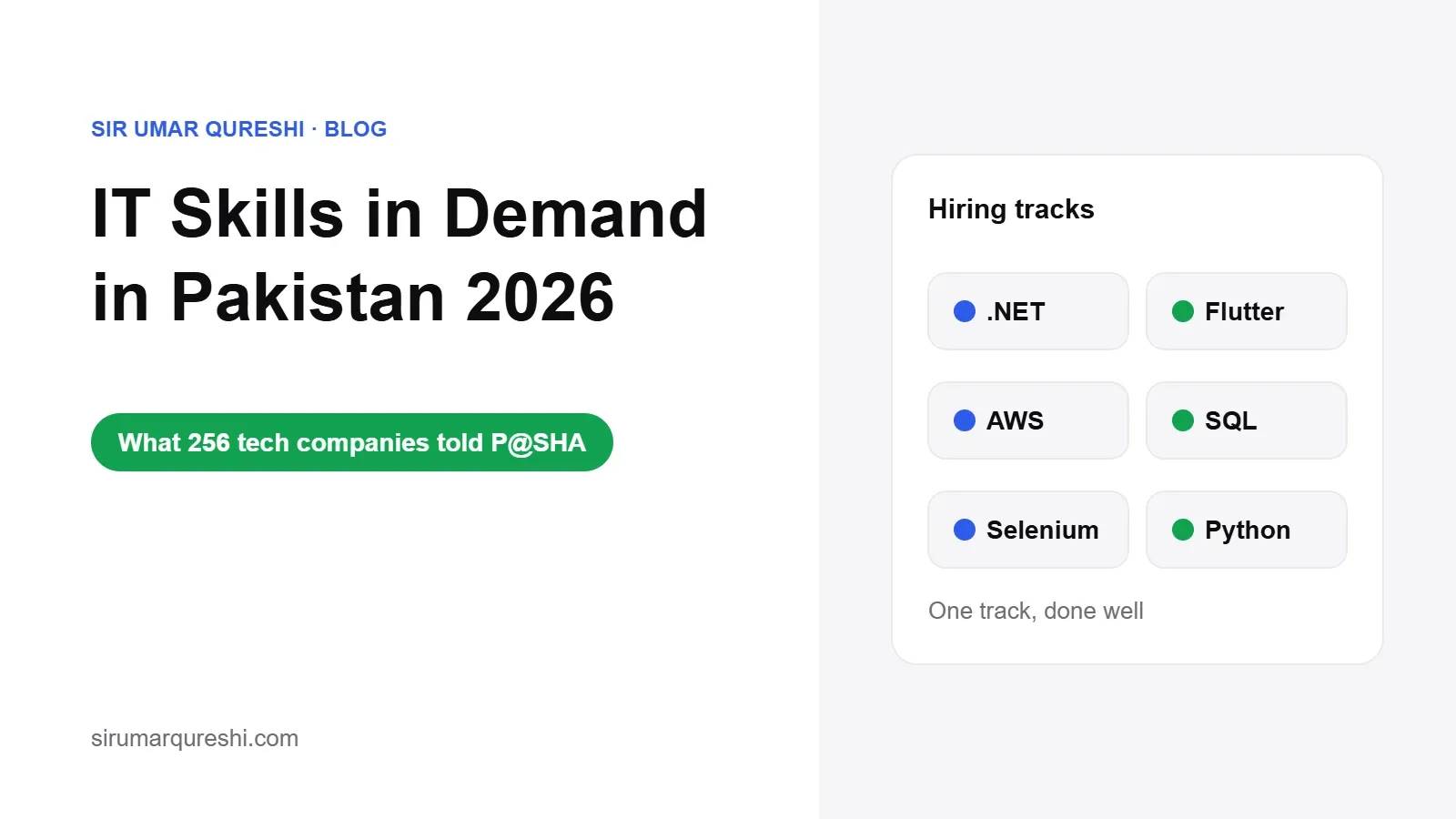
The IT skills in demand in Pakistan right now are .NET and full-stack JavaScript, Python, React Native and Flutter, cloud on AWS and Azure, relational databases, software testing, and practical AI tools. That is what 256 local tech companies told P@SHA in its latest skills survey. The catch is that most openings want experience, so a fresh graduate needs proof of work, not just a certificate.
This report goes through the data skill by skill. You will see what employers named, where beginners have a fair chance, and how to turn one skill into something a hiring manager can check in five minutes. I teach computer science and build production software, so the advice stays practical: what to learn, what to build and what to skip.
What Are the IT Skills in Demand in Pakistan Right Now?
The most useful source here is the P@SHA Skills Survey 2025. P@SHA is the industry body for Pakistan's software houses. For this report it asked 256 IT and IT-enabled services companies what they hire for. Small and medium firms made up most of the sample, which is close to the real shape of our industry.
The companies reported 32,685 open technical roles. They also said 61,515 existing roles need upskilling and 61,155 need reskilling. Read those two numbers together. Employers are not only looking for new people. They are also asking their current staff to learn new tools.
Here is the short version of what the survey ranks highest in each area:
- Web engineering: full-stack JavaScript, .NET and Python lead, and the report says .NET demand is now above full-stack JavaScript.
- Mobile: React Native and Flutter, especially for entry-level roles.
- Cloud: AWS developer skills at entry level, then Azure, DevOps and Kubernetes.
- Databases: relational databases such as Oracle, MySQL and MS SQL at every level.
- Testing: ISTQB, Selenium and Cypress, with Playwright growing.
- Enterprise platforms: Salesforce and Microsoft Dynamics 365, plus MuleSoft for integration.
- AI: skills with OpenAI tools, TensorFlow and DataRobot.

You do not need all of this. Among the IT skills in demand in Pakistan, you need one track, done well, with a small set of supporting skills. The rest of this article helps you choose that track and lists the tech skills to learn in 2026 for each one.
The Big Picture: Strong Exports, Tough Entry
The sector itself is growing. According to State Bank data reported by The Express Tribune, Pakistan's IT exports reached a record $4.6 billion in FY2025-26, up 21% from $3.814 billion the year before. The same report says freelancer export earnings crossed $1 billion for the first time.
Entry is harder than those headlines suggest, though. The P@SHA survey says nearly 72% of last year's hiring demand was for experienced professionals. It also estimates that around 72,952 CS and IT students graduate each year, counting accredited and non-accredited universities. P@SHA member companies hired 13,350 graduates in the last calendar year. That is roughly 18% of the yearly output.
The report also notes that tech openings have dropped, and it links much of that drop to AI taking over routine work. So the question for a student is not "Is IT a good field?" It clearly is. The real question is "What makes me one of the graduates who gets picked?"
What this means for you: the market rewards people who can show finished work. A degree gets you to the interview list. A live project, a clean GitHub history and clear communication get you the offer.
Web Engineering: .NET, Full-Stack JavaScript and Python
Web development is one of the widest doors into IT jobs in Pakistan. The survey names three stacks at the top. Full-stack JavaScript, .NET and Python lead, and the report concludes that .NET demand now exceeds full-stack JavaScript. Ruby on Rails and older legacy systems sit near the bottom.
Many students only think about JavaScript because it dominates YouTube tutorials. The .NET result is a useful reminder that many companies build business systems on Microsoft's stack, with C# and ASP.NET Core. If you like structured, typed code, this path is worth a serious look.
Which web stack should a beginner pick?
- Learn HTML, CSS and core JavaScript first. Every web stack depends on them.
- Pick one back-end language: C# with ASP.NET Core, Node.js, or Python with Django or FastAPI.
- Learn SQL properly alongside it. The survey shows relational databases are wanted at every level.
- Build one complete app with login, a database and a deployed link.
If you want the full order of topics, my web development roadmap for 2026 breaks it into stages with realistic time estimates.
Mobile Apps: Why React Native and Flutter Lead for Beginners
For mobile roles, the survey puts React Native and Flutter on top, and it says this is especially true for entry-level jobs. Native Android, iOS, Xamarin and Ionic come second. P@SHA even recommends that training programs start beginners on these cross-platform frameworks and save native tracks for mid-level and senior developers.
This makes sense from a business view. A software house can ship one codebase to Android and iPhone, which saves the client money. For you, it means one framework opens two app stores.
A simple rule helps here. If you already know JavaScript from web work, React Native is the shorter step. If you are starting fresh and like a clean, typed language, Flutter with Dart is a good choice. Either way, publish one small app that solves a real problem, such as a fee reminder or a class timetable.
Cloud, DevOps and Databases: The Hiring Backbone
Cloud skills appear in almost every modern job post, even when the title says "developer". The survey says AWS developer certifications are strongest at entry level, with Azure, DevOps and Kubernetes following.
Global developer data points the same way. In the Stack Overflow 2025 Developer Survey, which had more than 49,000 respondents, Docker use rose to 71%, up 17 points in a year. PostgreSQL ranked first among databases that developers plan to use.
Databases deserve special attention. The P@SHA survey says relational databases such as Oracle, MySQL and MS SQL have the highest demand at all levels. NoSQL options such as MongoDB are growing at mid and senior levels. SQL is easy to underrate because it looks simple. It is also one of the easiest skills to test in an interview, because a weak query shows up at once.
A practical cloud starter set
- Write SQL joins, grouping and indexes without looking them up.
- Put one app in a Docker container and run it on a cloud server.
- Learn the basics of one cloud: storage, a virtual machine, a managed database and access permissions.
- Set up a simple pipeline that deploys your code when you push to GitHub.
Testing and QA: An Underrated Door Into Tech
Software testing rarely gets attention from students, yet it has a clear place in the survey. ISTQB certification, Selenium and Cypress lead, and Playwright is gaining ground. Testing is a good fit if you are careful, enjoy finding faults, and like to understand how a whole product works.
Manual testing alone is not enough anymore. Employers want testers who can write automated tests in code. That means you still need basic programming, usually JavaScript or Python, plus one automation tool. A portfolio here can be a public repo with a test suite for a demo website and a short report of the bugs you found.
Enterprise Platforms: Salesforce, Dynamics 365 and Integration
This is the area most students never hear about in university. The survey says Salesforce and Microsoft Dynamics 365 are the most sought-after CRM and ERP platforms. For connecting systems together, MuleSoft leads, followed by Apache Camel and Dell Boomi.
These skills sit between business and code. A company might want its sales records, invoices and support tickets to share data. Someone has to configure the platform, write the logic and connect it to other systems. If you enjoy business processes as much as programming, this path has less competition than general web development.
The honest drawback is that practice access can take effort. Both vendors offer free learning material and trial or developer environments, so check their current terms before you commit to a paid course.
Which AI Skills Do Employers Actually Want?
Everyone wants to "learn AI", but the survey gives a more precise picture. It counted 638 openings asking for skills with OpenAI tools, spread across all experience levels. TensorFlow had 511 openings, strongest for people with two to five years of experience. DataRobot, a niche automated machine learning tool, had 398.
The report's wider point matters more than the counts. Employers increasingly want people with several skills who can use AI to automate workflows and work faster. In other words, AI is becoming a layer on top of your main skill, not a separate job title for most people.
Worldwide data agrees. The World Economic Forum's Future of Jobs Report 2025 lists AI and big data as the fastest-growing skills, followed by networks and cybersecurity, then technological literacy. It also expects 39% of workers' core skills to change by 2030.
At home, the government's Pakistan Economic Survey chapter on IT says the National AI Policy 2025 aims to train 200,000 people in AI each year. So you will not be the only one with "AI" on your CV. Depth and real projects will separate you.
AI skills worth learning first
- Calling an AI model's API from your own code and handling errors and costs.
- Building a small tool that reads your own documents and answers questions about them.
- Python with pandas for cleaning data before any model sees it.
- Judging AI output: testing it, catching mistakes and knowing when not to use it.
That last point is important. In the Stack Overflow survey, 84% of developers said they use or plan to use AI tools, yet 46% said they do not trust the accuracy of the output. Forty-five percent said debugging AI-generated code takes a lot of time. A junior who can check AI work carefully is more valuable than one who pastes it. If you want to try models without paying for an API, see my guide to running LLMs locally.
Soft Skills That Decide Who Gets Hired
Technical skill gets you shortlisted. Soft skills often decide the offer, because so much of our industry serves foreign clients. The P@SHA report lists the soft skills employers want most:
- Clear spoken and written communication.
- Working well in a team.
- Handling clients and solving their problems.
- Adapting to remote and multicultural work.
- Work ethic and professional behaviour.
English is the default business language, the survey says. It also notes growing demand for Arabic for Gulf clients, plus French, Spanish, German, Mandarin and Japanese. The WEF report adds that seven in ten employers see analytical thinking as a core skill.
You can practise all of this cheaply. Write a short README for every project. Explain one technical idea to a friend each week. Record a three-minute video walking through your code. These habits show up in interviews faster than any certificate.
How Do You Pick Your Track? A Side-by-Side Comparison
Use this table to match a track to your interests. The "entry signal" column comes from what the P@SHA survey says about junior hiring in each area.
| Track | Core tools named in the survey | Entry signal | Good fit if you |
|---|---|---|---|
| Web engineering | .NET, full-stack JavaScript, Python | Leads web demand; .NET now ahead | Like building complete products |
| Mobile apps | React Native, Flutter | Recommended start for beginners | Enjoy visual, user-facing work |
| Cloud and DevOps | AWS, Azure, Kubernetes | AWS developer skills strongest at entry | Like systems, servers and automation |
| Testing and QA | ISTQB, Selenium, Cypress, Playwright | Clear demand, less crowded | Are careful and detail-focused |
| Enterprise platforms | Salesforce, Dynamics 365, MuleSoft | Niche, less competition | Enjoy business processes |
| AI and data | OpenAI tools, TensorFlow, Python | OpenAI skills wanted at all levels | Like data, logic and experiments |
If you are still unsure, choose web engineering or mobile. Mobile is the survey's recommended start for beginners, and web skills carry over to every other track. Data lovers can follow my data science roadmap instead.
How Do Employers Test These Skills for Fresh Graduates?
Knowing the most in-demand IT skills is half the work. The other half is proving them under pressure. Hiring steps differ from company to company, but most junior interviews check the same few things.
- A short coding task. Expect loops, arrays, strings and simple logic in your track's language.
- A SQL question. A join, a group-by or a query that finds duplicates is common.
- A walk through your project. The interviewer asks why you chose a design and what you would change.
- A Git question. Branches, merges and how you fix a conflict.
- A communication check. Can you explain a technical idea in plain English?
The project walk-through is where many candidates lose marks. They built the app by following a video, so they cannot explain the choices. Build at least one project on your own, from a blank folder, and you will handle this part with confidence.
The skills for fresh graduates that matter most are judged on depth, not breadth. One interviewer question such as "What happens if two users update the same record?" tells them more than a list of ten tools on your CV. When you study, keep asking "why does this work?" and not only "how do I make it run?"
A 90-Day Plan to Become Hireable
Ninety days will not make you a senior developer. It can, however, turn you from "student with a course certificate" into "candidate with proof". Here is a simple plan built around what the survey says employers want.
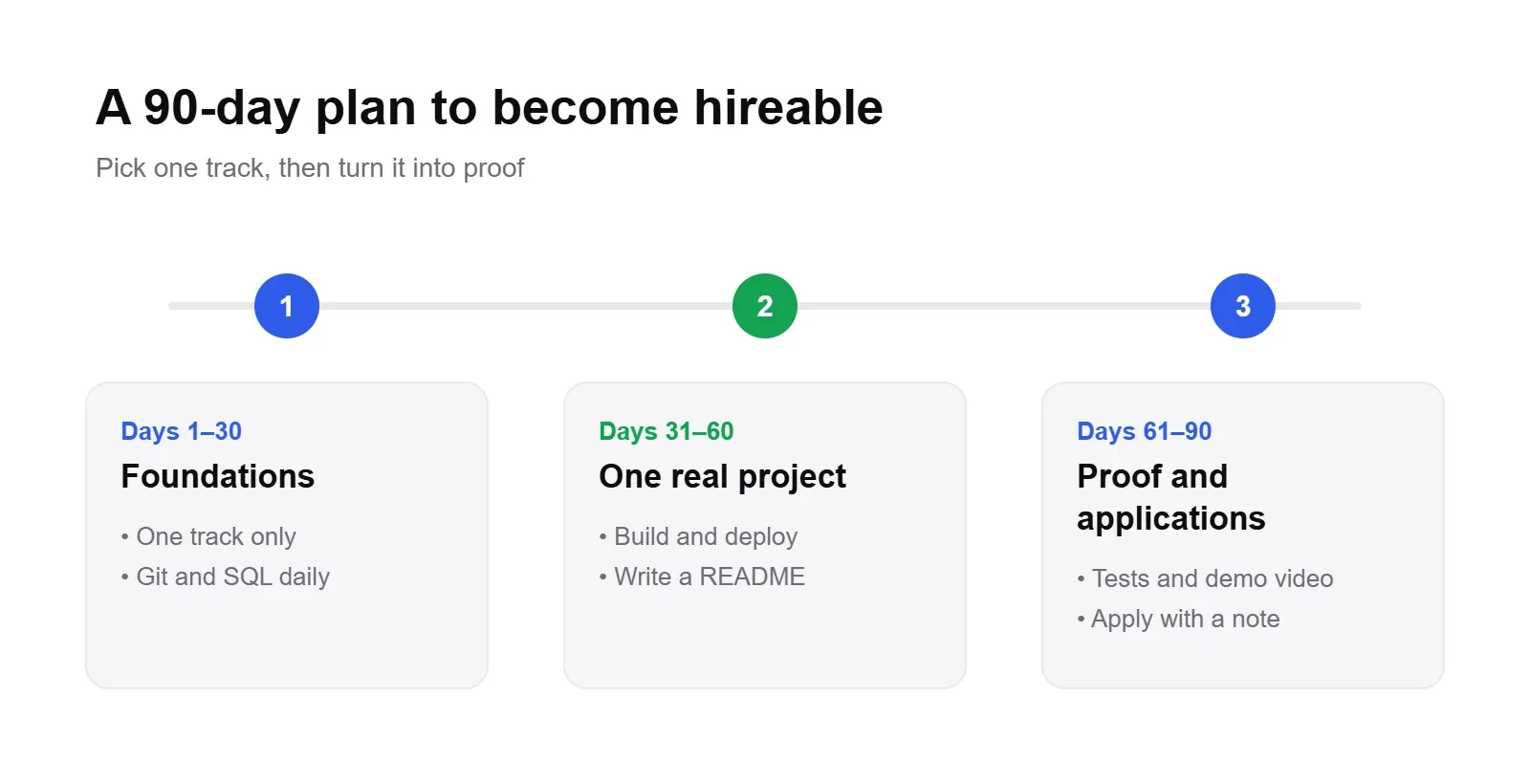
Days 1 to 30: Foundations
- Choose one track from the table above and write it down.
- Study its core language every day, even for one hour.
- Learn Git and push your practice code to GitHub daily.
- Practise SQL alongside, whatever your track.
Days 31 to 60: One real project
- Pick a problem from your own life, college or a local business.
- Build a small but complete version and deploy it to a live link.
- Add one AI feature only if it truly helps the user.
- Write a README that explains the problem, the stack and how to run it.
Days 61 to 90: Proof and applications
- Add tests and fix the bugs they find.
- Record a short demo video and add it to your CV and LinkedIn.
- Apply to roles that match your track, and send a short, personal note each time.
- Ask for feedback after each interview and improve one thing.
Tip: one finished, deployed project beats five half-done tutorial clones. Many interviewers look at your GitHub, so keep your best repo pinned at the top.
Free and Low-Cost Ways to Learn These Skills
You do not need an expensive course to start. The government-backed DigiSkills.pk program offers its courses free, with free e-certificates. Its Batch-03 list included new courses such as AI using Python and UI/UX with Webflow, plus an updated Data Analytics and Business Intelligence course. Its 300,000 seats filled up, so watch the site for the next batch.
The Economic Survey says DigiSkills has delivered more than 5.14 million trainings so far. That scale is good news for access, but it also means a DigiSkills certificate alone will not make your CV stand out. Pair it with a project.
Official documentation is the other free resource students skip. Microsoft, AWS, Flutter, React and Python all publish clear learning paths. Reading docs is also a real job skill, because it is exactly what working developers do every day.
If you are comparing paid institutes, my checklist on how to choose a computer course without wasting money will help you spot weak programs before you pay.
Mistakes Students Make When Chasing "Hot" Skills
These mistakes are common among learners, and each one costs months.
- Switching tracks every month. You end up with five beginner skills and no job-ready one.
- Collecting certificates without projects. The survey shows employers want experience. Projects are the closest substitute.
- Learning AI before programming. AI tools speed up people who already understand code. They confuse people who do not.
- Ignoring SQL and Git. Both appear in almost every role, and both are easy to test in an interview.
- Weak written English. Clients judge you by your messages long before they see your code.
- Copying AI output without checking it. Nearly half of developers in Stack Overflow's survey do not trust AI accuracy, and your interviewer is likely one of them.
Be careful with "guaranteed job" offers. No course can promise a job when, by P@SHA's own numbers, member companies hired only about 18% of yearly graduates. Judge a program by the projects its students finish.
What About Freelancing Instead of a Job?
Freelancing is a real option, and the numbers keep growing. The Economic Survey reports that tech freelancer exports reached $856.3 million in July to March of FY2026, up 51% from the year before. The skills employers want are mostly the same skills clients buy online.
The difference is that freelancing adds sales, pricing and client management on top of the technical work. For many beginners, a year or two in a job first teaches team habits, code review and client communication. Freelancing on the side can come after that. If you want to go straight to clients, read my step-by-step freelancing guide first.
Your One Step This Week
Open the comparison table above and pick one track today. Then spend this week building the smallest useful thing in that track and pushing it to GitHub with a clear README. That single repo is the start of the proof employers are asking for.
If you want structured guidance, see how I teach computer science and programming, or get in touch with questions about which track suits you. The IT skills in demand in Pakistan will keep shifting, but the habit of learning one thing deeply and showing your work will keep paying off.