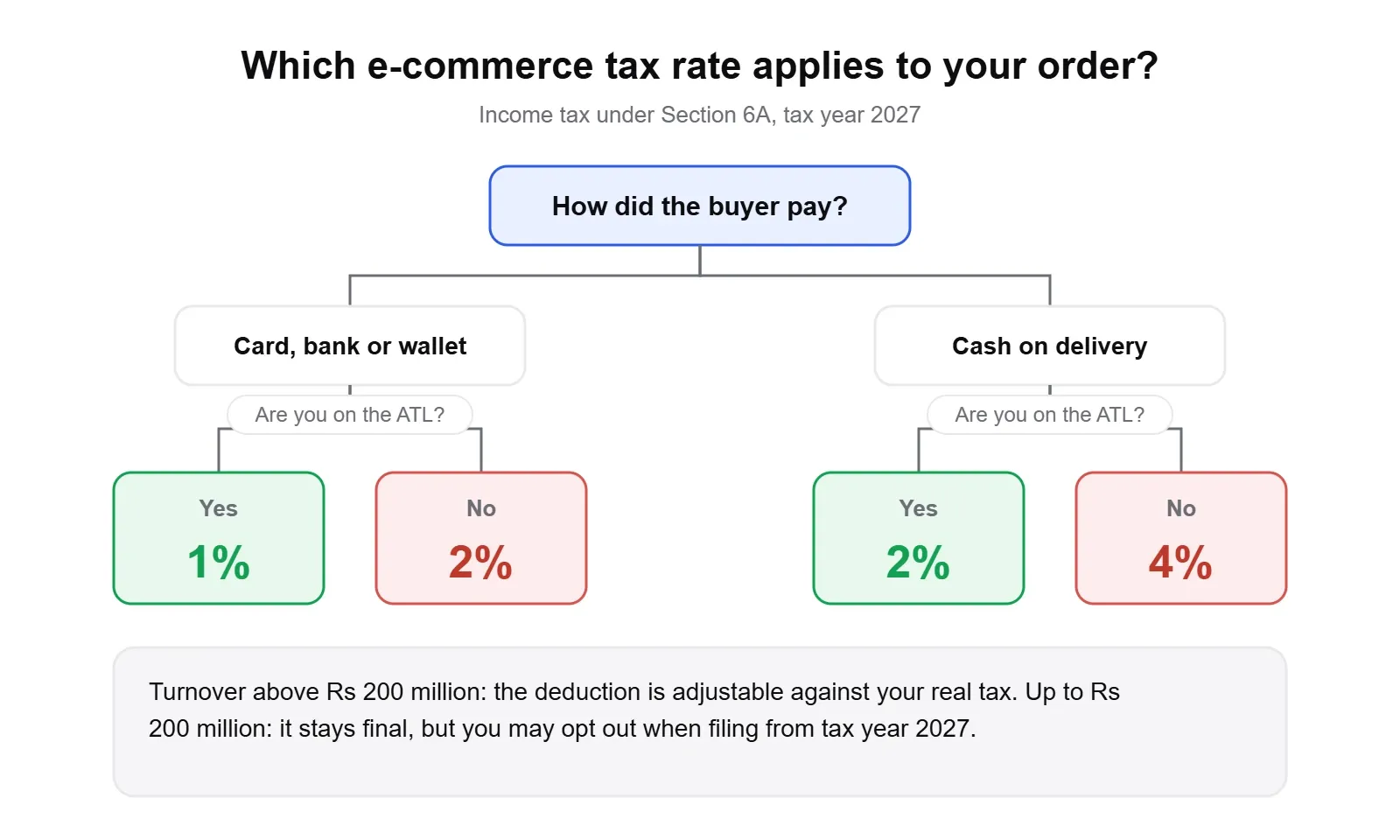
E-commerce tax in Pakistan works mostly at the source: when a buyer pays you online, the bank or gateway keeps 1% as income tax, and when a courier collects cash on delivery, it keeps 2%. Those figures are for sellers on the Active Taxpayer List, and they double if you are not on it. Sales tax is also withheld on digitally ordered goods, and every online seller now needs an NTN before a marketplace or courier is allowed to serve them.
That is the short version. The long version matters because the tax on online sellers comes out of every single order, whether you made a profit or not. In this guide you will see who takes what, why your payout is smaller than your sales, how to register, and how to keep the records that protect you. I will also walk through one realistic example order so the numbers stop feeling abstract.
Read this first: I am a teacher and software developer, not a tax adviser. Every rate below is linked to the FBR document or report it came from, but tax rules change with each budget. Confirm your own case with a qualified tax practitioner before you file.
What Changed for Online Sellers in 2025 and 2026?
Until mid-2025, many small online sellers in Pakistan never dealt with the tax office at all. The Finance Act 2025 changed that. It brought domestic e-commerce into a new section of the Income Tax Ordinance, Section 6A, and turned the companies that move your money into tax collectors.
According to Dawn's report on the FBR circulars, payment intermediaries such as banks and digital gateways now withhold 1% on e-commerce payments, while couriers deduct 2% on cash-on-delivery orders before paying sellers. The lower digital rate is meant to push buyers and sellers toward cashless payments.
Registration became compulsory at the same time. ProPakistani reported that, from 1 July 2025, online marketplaces and couriers may not serve sellers who are not registered with the FBR. In plain terms: no NTN, no listings and no deliveries.
Then the Finance Act 2026 adjusted the rules again, from 1 July 2026. The two biggest changes for sellers, covered in detail below, are about whether the 1% or 2% is your final tax or only an advance. There is also good news for anyone who buys software or ads from abroad: KPMG notes that the digital presence proceeds tax on foreign vendors was suspended back to 1 July 2025.
How Does E-commerce Tax in Pakistan Work at the Source?
Think of it as a toll on the road your money travels. You never send this tax to the FBR yourself. Instead, whoever hands you the buyer's money deducts it first, deposits it in the treasury, and reports it under your NTN.
Who that "whoever" is depends on how the buyer paid and where you sell. The FBR's Sales Tax Circular No. 02 of 2025-26 sets out the chain clearly:
- Your own website or app, paid online: the acquiring bank (the bank behind your payment gateway) withholds the tax.
- A marketplace such as Daraz, paid online: the bank that makes the final settlement from the marketplace to you is the withholding agent. The banks in the first step, from buyer to marketplace, are left out.
- Cash on delivery, anywhere: the courier, or the delivery aggregator that collects the cash, withholds the tax. If you use a marketplace's own delivery service, the marketplace can count as the courier.
These agents also have paperwork. KPMG says payment intermediaries and couriers must deposit the tax and submit monthly statements by the 10th of the following month. That is why the deduction shows up on your settlement statement with your NTN attached.
Income Tax Rates: Digital Payments vs Cash on Delivery
The official numbers for the current tax year sit in the FBR Withholding Tax Rates Card for Tax Year 2027, which covers 1 July 2026 to 30 June 2027. The tax is charged on the gross amount payable, not on your profit.
| How the buyer paid | Who deducts it | On the Active Taxpayer List | Not on the list |
|---|---|---|---|
| Card, bank transfer, wallet or other digital channel | Payment intermediary (bank or gateway) | 1% of gross amount | 2% of gross amount |
| Cash on delivery | Courier service | 2% of gross amount | 4% of gross amount |
Two lessons jump out of that table. First, cash on delivery costs you twice as much tax as a prepaid order. Second, staying off the Active Taxpayer List (ATL) doubles both rates. A seller who is not on the ATL and relies on COD loses 4% of every order before costs.
Where do content creators fit?
If you also earn from YouTube, Facebook, Instagram or TikTok, that money falls under a separate rule. The same FBR rate card lists 5% for creators on the ATL and 10% for those who are not, under Section 154B. Banks deduct it when the platform's payment reaches your account, so keep it separate from your product sales in your records.
Is the 1% or 2% Your Final Tax? The Rs 200 Million Line
This is the question that confuses most sellers, and the answer changed in July 2026. Under the 2025 rules, the Section 6A deduction was a final tax: once it was taken, your income tax on those sales was settled.
The KPMG brief on the Finance Act 2026 explains the new split:
- Turnover above Rs 200 million in a tax year: the tax becomes adjustable. You file a normal return, work out your real tax on profit, and count the amounts already withheld against it.
- Turnover up to Rs 200 million: the final-tax treatment stays, but you may now opt out of it when you file your return, from tax year 2027 onward.
Why would a small seller opt out? Because a final tax on gross sales ignores your costs. If your margins are thin or you made a loss, a tax on profit could be lower than 1% or 2% of turnover. If your margins are healthy, the final regime is usually simpler. This is exactly the decision to make with an accountant, using your real yearly figures.
Before that meeting, bring answers to four questions:
- What was your total turnover for the year, including COD and prepaid orders?
- How much tax did banks, gateways and couriers already withhold under your NTN?
- What did you spend on stock, delivery, packaging, returns and advertising?
- Do you have invoices and statements to prove those costs?
If you cannot answer the last question, the opt-out will be hard to support, and staying in the final regime is usually the safer path until your records improve.
What About Sales Tax on Digitally Ordered Goods?
Income tax is only half of the picture. The Finance Act 2025 also pulled e-commerce vendors into the sales tax system. The FBR's Budget 2025-26 salient features say the sales tax withholding scope was extended to online payments and cash on delivery, and that the withholding rate was set to rise from 1% to 2%.
How that withheld sales tax treats you depends on what kind of business you are, according to the FBR circular:
- Cottage industries and retailers other than Tier-1 retailers: the tax collected by the bank or courier counts as the final discharge of your sales tax liability. You cannot claim input tax on these supplies.
- Everyone else: the normal sales tax regime applies, and the amount withheld can be adjusted against the output tax in your sales tax return.
The collection system for this went live through IRIS in early 2026. Profit by Pakistan Today reported in February 2026 that payment intermediaries, couriers and marketplaces now deduct sales tax from supplier payments and file monthly statements, while marketplaces report the total value of all transactions on their platforms.
Your settlement statement may therefore show more than one tax line. Do not assume one figure is everything, and do not assume two lines mean you were charged twice. Ask your marketplace or courier for a breakdown that names each deduction and the section of law behind it.
A Worked Example: One Rs 10,000 Order
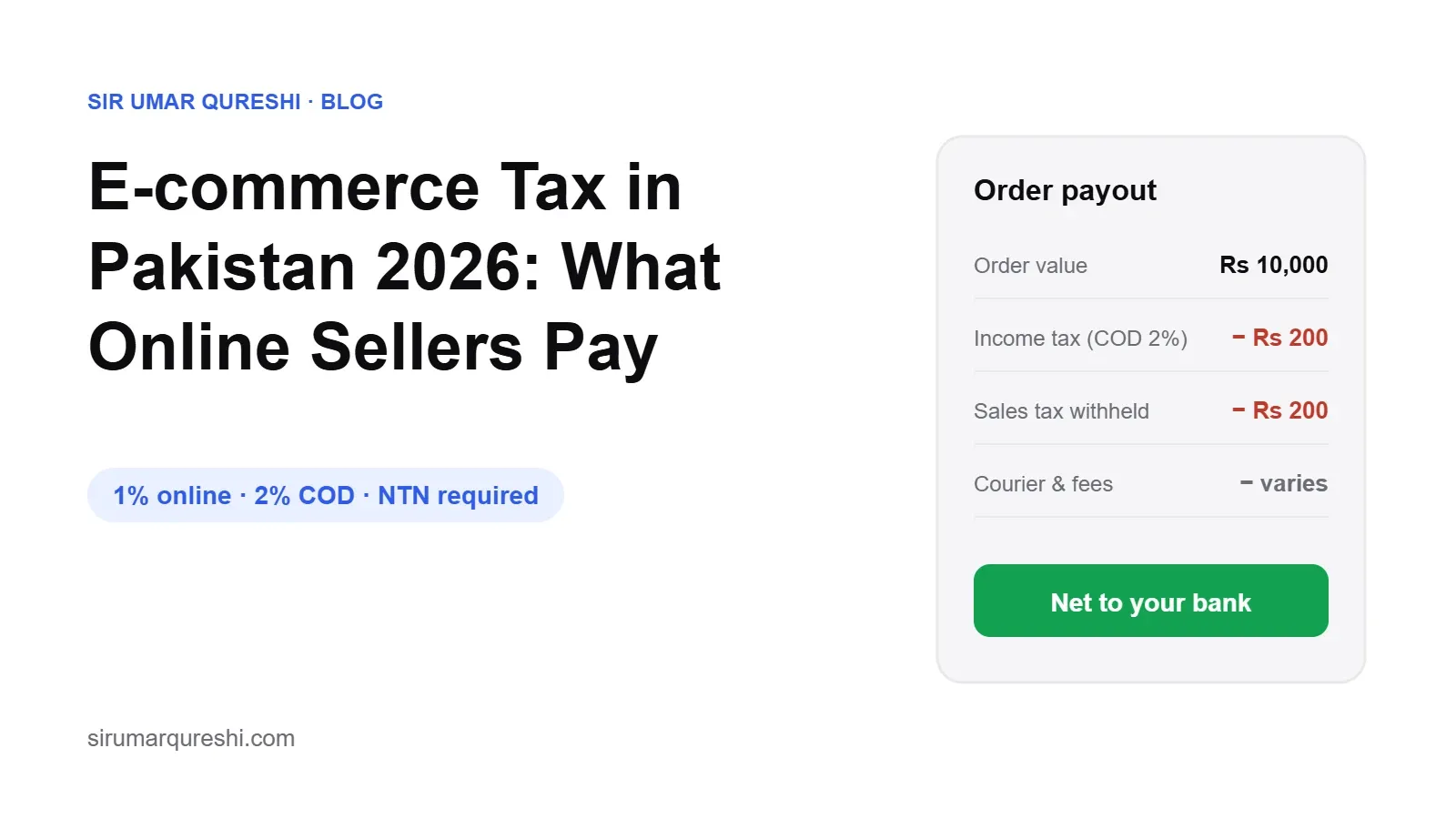
Here is a clearly labelled example, not a real shop. Ayesha runs a small home décor store from Abbottabad. She sells a lamp for Rs 10,000 through her own website. She is on the ATL, and she is not a Tier-1 retailer.
| Line on her statement | Buyer pays by card | Buyer pays cash on delivery |
|---|---|---|
| Order value | Rs 10,000 | Rs 10,000 |
| Income tax under Section 6A | Rs 100 (1%) | Rs 200 (2%) |
| Same tax if she were not on the ATL | Rs 200 (2%) | Rs 400 (4%) |
| Sales tax withheld at the 2% budget rate | Rs 200 | Rs 200 |
On these assumptions, a prepaid order loses about Rs 300 to tax and a COD order about Rs 400, before gateway fees, delivery and returns. Over 300 orders a month, the gap between card and COD alone is Rs 30,000 of income tax. That is a real reason to offer a small discount for prepaid orders.
Your own figures may differ, because the sales tax base and your category matter. Treat this table as a way to read your statement, then check the actual deductions line by line. If you want to understand how fees stack up on prepaid orders, my guide to choosing a payment gateway in Pakistan covers gateway charges in detail.
How Do You Register as an Online Seller? Step by Step
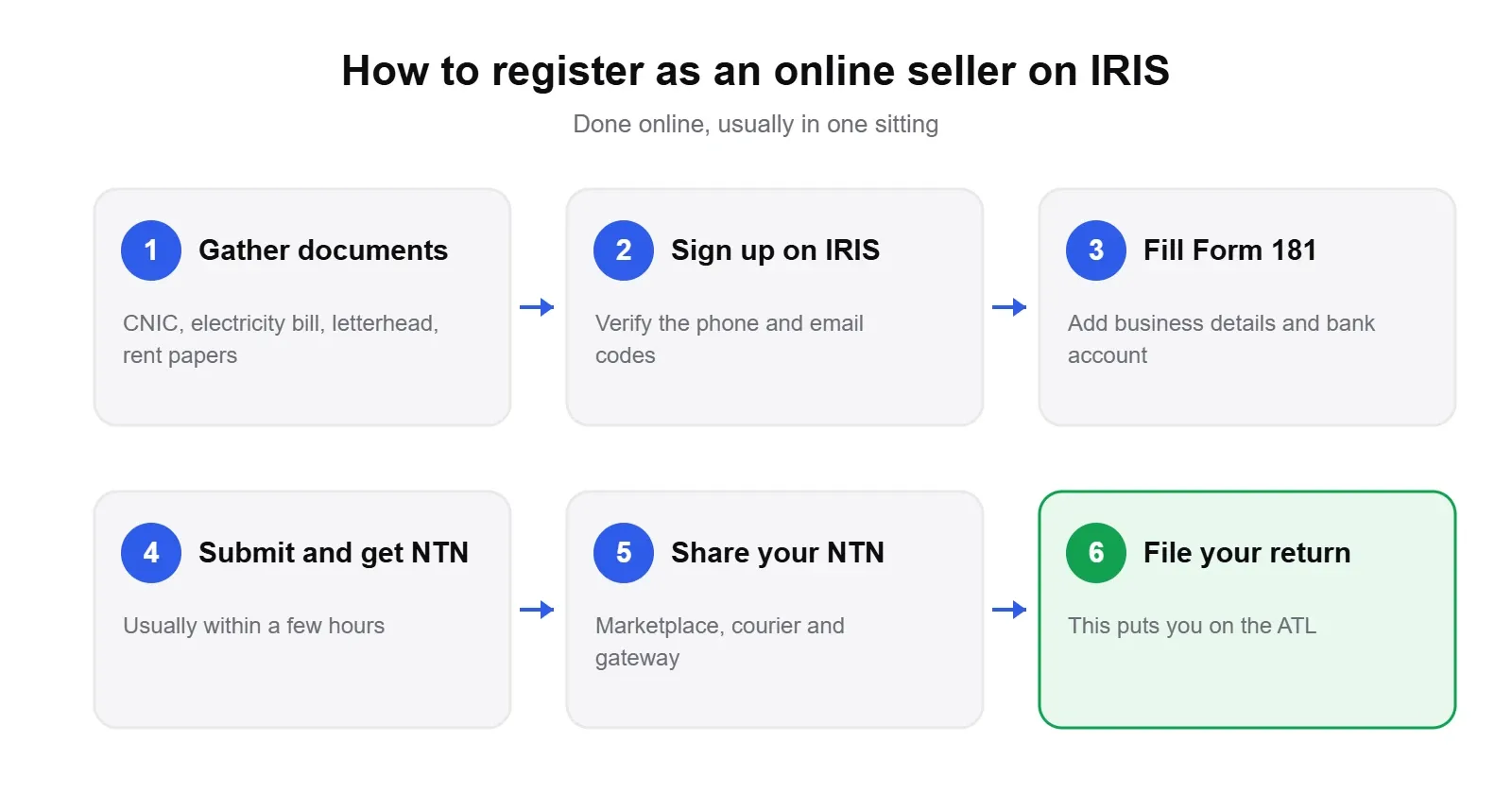
Registration happens online on the FBR's IRIS portal, and most sellers can finish it in one sitting. ProPakistani's NTN guide lists the steps and documents. Here they are in order:
- Gather your documents. For a business owner that means a copy of your CNIC, a recent electricity bill for the business location, a blank business letterhead, and property papers or a rent agreement, plus a working mobile number and email address.
- Open IRIS and choose registration for an unregistered person. Enter your CNIC, name, contact number, address and email.
- Verify both codes. IRIS sends one six-digit code to your phone and another to your email. Enter both and your login details arrive by SMS or email.
- Complete Form 181. Log in, open the Draft section and edit the 181 registration form. As a seller, fill the Business tab with your trade name, address and nature of business, and add your bank account.
- Attach documents and submit. Check every field, attach the scans and submit. The guide says the NTN usually follows within a few hours.
- Share your NTN with every platform. Add it to your Daraz or other marketplace seller profile, your courier account and your payment gateway, so deductions are credited to you.
- File your annual return. Getting an NTN does not put you on the ATL. You join the list by filing your income tax return, and you must keep filing to stay on it.
If your business is bigger or you sell taxable goods at scale, sales tax registration under Sections 14(1A) and 14(1B) also applies. The FBR circular says the same registration rule covers non-resident sellers who sell digitally ordered goods in or from Pakistan through marketplaces.
Do Home-Based and One-Time Sellers Have to Register?
This is one of the most searched questions, and the honest answer is "probably yes, if you use a courier or a marketplace". During the 2025 budget debate, Profit by Pakistan Today reported that the FBR chairman told the Senate finance committee that one-time sellers and women selling from home would be exempt from mandatory registration.
The circulars issued after the budget were stricter in practice. They say every e-commerce seller must register for income tax, and they bar marketplaces and couriers from serving unregistered sellers. So even if the law treats you gently, the platform you depend on will still ask for your NTN before it books your parcel or lists your product.
My advice to students who start a small side shop is simple. Register early, while your sales are tiny and your paperwork is easy. It is done online through IRIS, it keeps your deductions credited to your name, and it removes a reason for a courier to freeze your account later.
Is there a limit on cash payments?
There is one more cash rule worth knowing. Profit reported that the FBR's Income Tax Circular No. 02 of 2025-26 set a Rs 200,000 limit on cash-based transactions at retail outlets, and extended that limit to cash-on-delivery e-commerce orders. If you sell high-value items such as phones or furniture, plan to take larger orders through a bank or gateway rather than cash at the door.
Daraz, Your Own Website or Instagram: Does the Channel Change the Tax?
The rate does not change with the channel. A Rs 10,000 prepaid sale is taxed at 1% whether it came through Daraz, a Shopify or WooCommerce store, or a WhatsApp order paid by bank transfer through a gateway. What changes is who deducts it and where you will see it.
| Where you sell | Prepaid orders taxed by | COD orders taxed by | Where to find the deduction |
|---|---|---|---|
| Marketplace (Daraz and similar) | Bank settling the marketplace payout | Marketplace's courier or your courier | Marketplace payout statement |
| Your own website or app | Acquiring bank behind your gateway | Courier or delivery aggregator | Gateway settlement and courier COD report |
| Social media orders delivered by courier | Gateway, if you use one | Courier | Courier COD report |
One practical tip from building marketplace software: keep the order ID from your store on every courier booking. When the courier's tax report arrives, you can match each deduction to a real order in minutes instead of guessing. OnePlace, the multi-vendor marketplace I built for Pakistan, includes courier integration and seller dashboards, and order-level matching is one of the main reasons those features matter to sellers.
Which Records Should You Keep Every Month?
The withholding agents report your sales to the FBR whether you keep records or not. Your records are what let you prove the tax was already paid, claim adjustments, and answer any notice calmly. A simple monthly folder is enough:
- Marketplace payout statements and gateway settlement reports.
- Courier COD remittance reports showing the tax deducted.
- Bank statements that match each payout.
- Purchase invoices for stock, packaging and shipping.
- Advertising receipts, including foreign card payments for ads.
- A returns and cancellations log with order IDs.
- Your NTN certificate and IRIS acknowledgements.
This list follows the record-keeping advice in Baco Consultants' Daraz seller tax guide, which also suggests splitting each payout line into sales value, platform charges, logistics, adjustments, tax and net payout. If those six numbers do not add up, ask the platform's seller support for a breakdown.
A spreadsheet with one row per order, and columns for gross value, fees, tax withheld and net payout, will do most of the work. If you are new to that, my list of Excel formulas every job needs covers SUMIFS and XLOOKUP, the two formulas that make this reconciliation quick.
Common Mistakes That Cost Online Sellers Money
1. Getting an NTN and never filing
An NTN alone keeps your listings live, but it does not put you on the ATL. Without a filed return, every deduction is doubled, according to the FBR rate card. Baco Consultants also warns that late or missing returns can lead to penalties and loss of filer status.
2. Treating your payout as your sales
Your income is the order value, not the amount that lands in your bank. If you record only net payouts, your books will understate sales and you will lose track of the tax already paid.
3. Ignoring the opt-out decision
From tax year 2027, sellers under Rs 200 million can choose whether to stay in the final regime. Doing nothing is also a choice. Look at your margins before your return is due.
4. Pushing every customer to cash on delivery
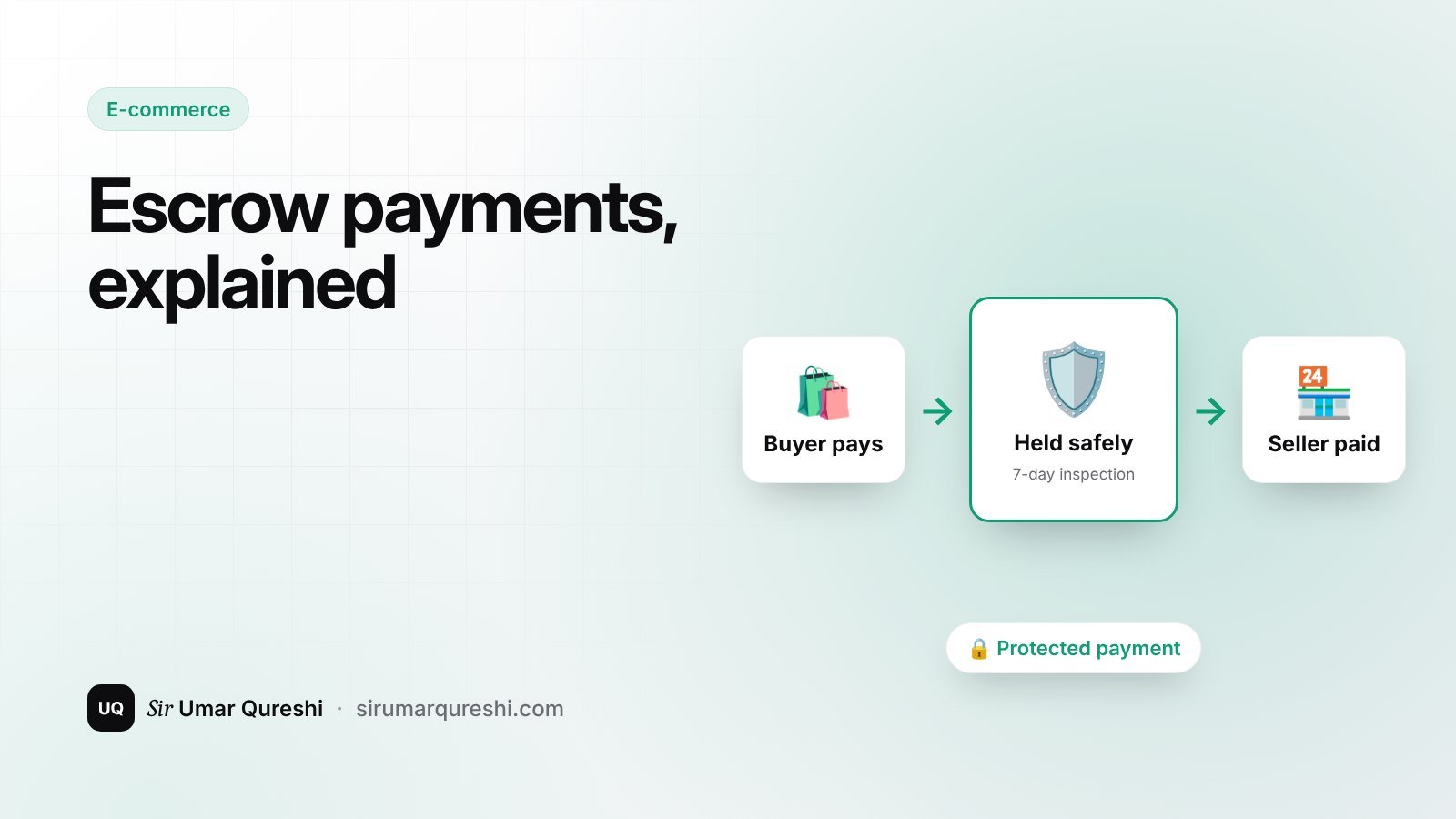
COD feels safe because buyers trust it. Yet the courier's 2% is double the digital rate, and COD brings refused parcels. Offering prepaid options, or an escrow-style payment that builds buyer trust, protects your margin.
5. Not reading the statements
Errors happen, especially with returns. Check each month that every deduction is credited to your NTN in IRIS. If a figure looks wrong, ask the platform for a written breakdown.
What Does This Mean for New Sellers in Pakistan?
For a student or a home-based seller testing a first product, e-commerce tax in Pakistan can look heavy, but the cost of compliance is mostly an hour of setup and ten minutes a month. The tax is taken for you. Your jobs are to register, file, and keep your papers tidy.
If you are still choosing products and platforms, start with my step-by-step guide to starting an online store and build the tax lines into your margin maths from day one. Price as if 2% to 4% of every COD order is already gone, because it is. Sellers who also freelance can see how foreign income is handled in the freelancing guide.
If you would like a store or marketplace with tax-ready order reports built in, you can see what I offer on the services page, or send me a message with your setup.
Your One Step This Week
Open your last month's payout statement from your marketplace, gateway or courier. Find every tax line, write down the amount and the section it cites, and check that your NTN appears on it. If you do not have an NTN yet, block one hour this week and complete the IRIS registration above. Everything else in e-commerce tax in Pakistan becomes easier once that single number is in place.