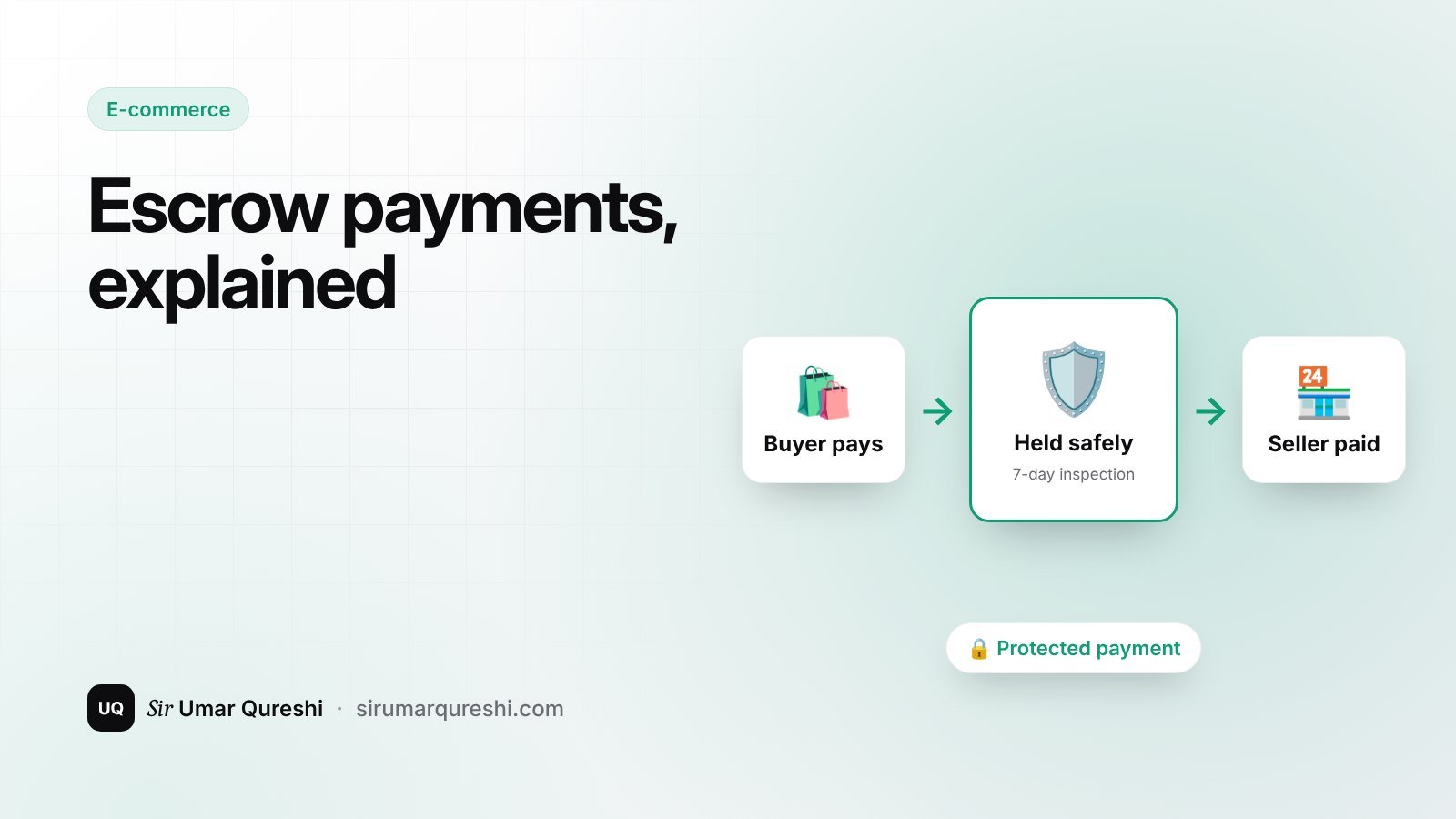
An escrow payment is money that a neutral third party holds during a deal and releases to the seller only after the buyer confirms delivery. If the item never arrives or isn't as described, the money stays put until the problem is settled. Neither side has to trust the other first.
Escrow is an old idea. Property lawyers have used it for generations. The internet made it an everyday tool, because you now buy from and sell to people you will never meet. A seller in another country can't hand you the goods and take your cash on the spot, so someone has to go first. With escrow, nobody does.
This guide explains how escrow works in practice, what licensed services charge, and why marketplace buyer protection is a different thing. It also shows you how scammers copy escrow sites. The final section covers Pakistan, where cash on delivery still rules and escrow is slowly closing the trust gap.
By the end, you'll know:
- The exact path money takes from buyer to escrow to seller
- How inspection periods and disputes decide who gets paid
- What a licensed escrow service costs, with worked examples
- Why a refund promise is not the same as money held in escrow
- How to spot a fake escrow website before you pay anything
What Is an Escrow Payment?
Every escrow deal has three parties: a buyer, a seller and an escrow agent. The agent is the neutral one. It has no stake in the sale. Its only job is to follow the conditions both sides agreed at the start, and to move the money when those conditions are met.
Think of it as a locked box with two keys. The buyer puts the money in. The seller can see it's there, which proves the buyer is serious. But the seller can't take it out until the buyer turns their key by accepting the goods, or until an agreed deadline passes.
That small change fixes the core problem of trading online. In a normal prepaid deal, the buyer carries all the risk. In a cash deal at the door, the seller carries most of it. With escrow, the money sits with a third party whose rules you can both read in advance.
You'll see escrow used most for things that are expensive or hard to judge from photos: vehicles, domain names, websites for sale, machinery and freelance projects. Many marketplaces also build a version of it into checkout, sometimes under names like "payment protection" or "funds on hold".
How Escrow Works, Step by Step
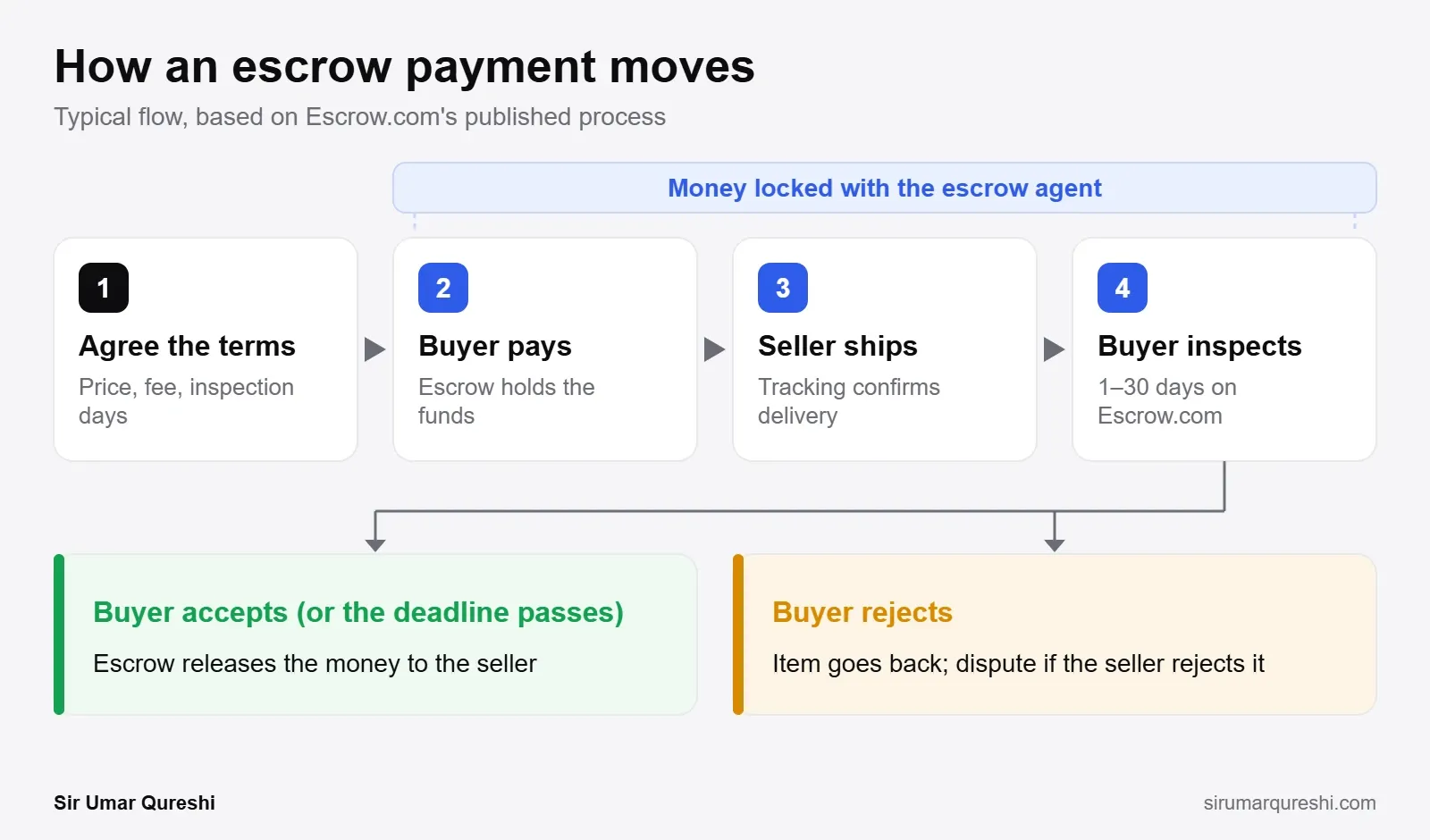
Providers differ in the details, but a typical escrow payment follows the same order everywhere. Escrow.com describes its process in five stages, and a sixth step covers what happens when things go wrong:
- Agree the terms. Either party opens a transaction. Both register and accept the same terms: price, item description, shipping method, who pays the fee and how long the buyer gets to inspect.
- The buyer pays into escrow. The money goes to the escrow company's own account, not to the seller. Once the payment is verified, the seller is told the funds are "in escrow".
- The seller ships. Only now does the seller send the item. They add the tracking number so delivery can be confirmed.
- The buyer inspects. The inspection clock starts on delivery. The buyer checks the item, then accepts or rejects it.
- The seller gets paid. On acceptance, the escrow company releases the money to the seller.
- Or the item goes back. If the buyer rejects it, they return the item, the seller inspects the return, and a dispute process starts if the two still disagree.
Notice the order. The seller never ships before the money is secured, and the buyer never pays the seller before seeing the goods. Each side takes one small, visible step, then waits for the other.
Who Holds the Money: Licensed Agents vs Platform Holds
This question matters more than any feature list. "Escrow" covers two quite different setups, and you should know which one you're using before you pay.
A licensed escrow company
A true escrow agent is a regulated business that holds client money for a living. On the same how-it-works page, Escrow.com says it's licensed as an escrow company in 48 US states. It adds that California's Department of Financial Protection and Innovation lists it as a licensed firm, and that each state's regulator audits it regularly.
That outside oversight is the whole point. A regulator, not just the company's own marketing, stands behind the claim that your money is where it should be. It also gives you somewhere to complain if it isn't.
A marketplace holding funds
Most marketplaces don't use a separate escrow company. They collect your payment, keep it in their own payment system for a while, and pay the seller later. Some call this escrow. In practice it's closer to a payment hold. The marketplace writes the rules and judges disputes itself.
That isn't automatically bad. A large platform often settles problems faster than a formal escrow dispute. But the model decides who judges your case and how long money can be held, so read the policy before a big order.
The Inspection Period: Your Window to Check the Goods
The inspection period is the heart of any escrow payment. It's the time the buyer gets after delivery to examine the item and decide. Too short, and the buyer can't test properly. Too long, and the seller waits weeks for money they've already earned.
On Escrow.com, the inspection period can run from 1 to 30 calendar days, and everyone agrees on the length when the deal is created. A few rules are worth knowing:
- Shipping time doesn't count. The clock starts when the buyer marks the item as received, or when the escrow company confirms delivery.
- Silence means yes. If the buyer does nothing before the period ends, the item is treated as accepted and the seller is paid.
- Rejecting has a cost. A buyer who rejects must ship the item back within 10 calendar days and pays the return shipping and insurance.
- The seller inspects too. The seller gets 5 days to check the returned item. Once they confirm it, the buyer is refunded, minus the escrow fee, which the company keeps.
Match the length to the item. A phone can be tested in a day or two. A used car may need a mechanic's report, and a website sale may need time to check traffic data and move accounts across. Agree on the window before anyone pays, not after a problem appears.
What Happens If the Buyer and Seller Disagree?
Disputes are where escrow earns its fee. Under Escrow.com's published dispute process, a formal dispute only exists once the buyer has returned the item and the seller rejects the return. From there it follows a fixed path:
- Tell the escrow company. Both parties email the support team, which moves the deal into a negotiation period.
- Negotiate for 14 calendar days. Buyer and seller try to settle on their own. If they agree, they send the terms to the escrow company in writing.
- Start arbitration within another 14 days. If talks fail, the parties must open binding arbitration with a provider such as the American Arbitration Association, net-ARB or JAMS. The parties pay the arbitration costs, not the escrow company.
- Fallback. If nobody starts arbitration in time, the escrow company may cancel the deal and refund the buyer, minus its fee.
The key point is that a licensed escrow agent doesn't pick a winner. It holds the money and acts on instructions from both parties or an arbitrator. A marketplace, by contrast, usually reviews the evidence and makes the call itself. If you sell, learn which system you're under before you list.
Whatever system you use, evidence wins disputes. Sellers should photograph the item and its packaging before shipping. Buyers should record an unboxing video when a parcel arrives. Both should keep every message on the platform, where it can be reviewed later.
How Much Does an Escrow Payment Cost?
Licensed escrow isn't free, and the fee structure surprises people on small deals. Escrow.com's published fee schedule for standard merchandise uses a sliding percentage, with a minimum fee at each tier:
| Transaction amount (USD) | Standard fee | Minimum fee |
|---|---|---|
| Up to $5,000 | 2.6% | $50 |
| $5,000.01 to $50,000 | 2.4% | $130 |
| $50,000.01 to $200,000 | 1.9% | $1,200 |
| $200,000.01 to $500,000 | 1.5% | $3,800 |
| $500,000.01 to $1,000,000 | 1.2% | $7,500 |
Here's what those rates mean for a few everyday deals:
- An $800 phone: 2.6% would be $20.80, but the $50 minimum applies. That's over 6% of the price.
- A $3,000 laptop: 2.6% comes to $78.
- A $20,000 car: 2.4% comes to $480.
How you pay changes the bill too. The same schedule adds a 3.05% processing fee for card or PayPal payments on deals up to $5,000. Buyers paying by international wire pay an extra $25 bank fee. Sellers pay small payout fees: $10 for a US wire and $20 for an international one, while ACH transfers are free.
Who pays is up to you. The fee can be added to the buyer's price, taken from the seller's proceeds, or shared. Agree on it in writing at the start. Splitting it evenly is a simple default that feels fair to both sides.
Escrow vs Buyer Protection: Why They Aren't the Same
Many shoppers assume the guarantee on a big marketplace is escrow. It usually isn't. Buyer protection is a refund promise. Escrow is money that hasn't reached the seller yet. The difference shows up when something goes wrong.
Take eBay's Money Back Guarantee. You can report an item that didn't arrive within 30 calendar days of the actual or estimated delivery date. The seller has 3 business days to respond, and after that you can ask eBay to step in. eBay says it may hold a seller's funds when a buyer reports a problem. That's a payment hold triggered by a complaint, not money parked from the start.
The exclusions tell you even more. eBay's guarantee doesn't cover motor vehicles, real estate, services, or businesses and websites for sale. Payments made outside eBay checkout, such as bank transfers or cash, aren't covered at all. Those are the big, hard-to-check deals where a separate escrow service makes the most sense.
| Question | Licensed escrow | Marketplace payment hold | Buyer protection program |
|---|---|---|---|
| Who holds the money? | A regulated escrow company | The marketplace's payment system | Often the seller, once paid out |
| When is the seller paid? | After acceptance or the inspection deadline | After delivery, plus a set delay | Usually soon after the sale |
| Who settles disputes? | The two parties or an arbitrator | The marketplace | The marketplace or payment provider |
| How do you pay for it? | A visible fee on each deal | Built into seller commission | Built into seller or card fees |
| Best suited to | Cars, domains, equipment, private sales | Everyday marketplace orders | Low and mid-value shopping |
Card chargebacks and payment-app protections work in the same after-the-fact way. They're useful, but they ask you to pay first and argue later. Escrow flips that order.
Milestone Escrow on Freelance Marketplaces
Freelance platforms use escrow for services, where "delivery" is a design file or a working feature rather than a parcel. The client funds the work before it starts, and money is released piece by piece. That's where the term milestone payments comes from. Each milestone is, in effect, a small escrow payment of its own.
On Upwork, fixed-price contracts need a deposit into project funds held in escrow. The client can fund the whole contract or only the first milestone, with a minimum of $5. After the freelancer submits work, the client has 14 days to approve it or ask for changes. If the client doesn't respond in that time, the money goes to the freelancer automatically.
That automatic release is what makes milestone escrow fair. A client can't keep the work and go quiet. A freelancer can't be strung along with unfunded promises, as long as they follow a few simple rules.
Rules that protect both freelancers and clients
- Never start a milestone until the platform shows it as funded.
- Break big projects into small milestones with clear deliverables, so a dispute only touches one piece.
- Keep files and approvals on the platform, where the record can be checked.
- Turn down any offer to "pay outside the platform to save fees". You lose the escrow and the dispute support in one move.
If you're just starting out, read the guide to freelancing in Pakistan next.
Fake Escrow Sites: How the Scam Works
Scammers know an escrow payment feels safe, so they copy it. The trick is simple. A seller, usually offering a great price, says they only trade through a particular escrow site. The site looks professional. You pay it. The site and the seller turn out to be the same people, and the item never existed.
Some fake sites borrow the name of a real, licensed firm. California's financial regulator, the DFPI, warned about four websites posing as All Points Escrow, a genuine licensed escrow company. The sites used invented contact details and made-up license numbers, and claimed a DFPI license they didn't hold. The real company doesn't even run a website. The regulator's advice is to verify any escrow company's license on its own site before doing business.
Watch for these warning signs:
- The other party insists on one specific escrow site and refuses a well-known one.
- You're asked to pay an individual or an "agent", or to use gift cards or money-transfer services.
- The domain was registered recently, even though the site claims years of history.
- There's no working phone line, or the license number doesn't match the regulator's records.
- The fees look far lower than any established escrow firm charges.

Warning: Never open an escrow site from a link the other party sends you. Type the address yourself, start the transaction yourself, and invite them into it. A genuine buyer or seller won't object.
When Is Escrow Worth It?
Escrow adds a fee and a few days of waiting. On some deals that's a bargain. On others it's overkill. Use this as a rough guide:
- Use licensed escrow for private sales of cars, domain names, websites, machinery or jewelry, and for any cross-border deal with a stranger.
- Use the marketplace's own protection for normal orders from established sellers, as long as you pay through the official checkout.
- Use milestone escrow for freelance or custom work that's delivered in stages.
- Skip escrow when the minimum fee would eat a big share of a small purchase, but then buy only from sellers with a real track record.
A quick test helps. If losing the full amount would genuinely hurt, and the seller has no reputation you can check, put the deal through escrow.
In Pakistan: Escrow in a Cash-on-Delivery Market
Pakistani shoppers built their own answer to the trust problem: pay the courier at the door. It works up to a point. You see the parcel before you hand over cash. But you rarely get to test the product first, and sellers absorb the cost of every refused parcel and fake order.
Where the numbers stand
Cash still leads. Pakistan's proposed e-Commerce Policy 2.0, dated June 2025, puts reliance on cash on delivery at 60–70% and sets cutting it as a goal.
Digital payments are catching up fast, though. The State Bank of Pakistan's Annual Payment Systems Review for FY26 reports that e-commerce merchants registered with banks rose from 9,584 in June 2025 to 23,356 in June 2026. It also found that almost 96% of e-commerce transactions processed through banks were paid from accounts and wallets, not cards.
The direction is clear: more Pakistani shoppers are paying online from wallets and bank accounts. Once money moves before delivery, the old question returns: who protects the buyer who has already paid? That's the gap an escrow payment fills.
What the State Bank allows
Holding other people's money is a regulated activity. In June 2023, the State Bank revised its rules for Electronic Money Institutions (EMIs), the licensed institutions that issue e-money wallets. The update lets them offer escrow services for domestic e-commerce transactions, along with payment aggregation and other new services. The proposed e-Commerce Policy 2.0 also lists escrow among the services a State Bank sandbox would test.
So if a platform in Pakistan says it holds your money in escrow, ask a fair question: whose account is it in? A bank, a licensed EMI and a marketplace's own merchant account each carry different levels of protection. When in doubt, check that the payment partner appears on the State Bank's website.
How OnePlace uses escrow-protected payments
OnePlace, the verified multi-vendor marketplace I built for Pakistani sellers, combines escrow-protected payments with a 7-day return window. Buyers can still pay cash on delivery, or use JazzCash or Easypaisa. Orders ship through integrated TCS and Leopards courier services.
Courier tracking matters for any escrow system. When delivery is confirmed by tracking data rather than someone's word, everyone knows when a return window starts. OnePlace also gives vendors a Seller Center, with separate admin and customer dashboards and mobile apps.
Practical tips for buyers and sellers in Pakistan
- Buyers: for anything expensive, choose a platform that holds prepaid money over paying a seller's personal wallet or bank account directly.
- Buyers: open the parcel on camera when it arrives, so you have evidence if you need to return it.
- Sellers: offer a small discount for prepaid orders on a protected platform. A paid order commits the buyer in a way a COD order doesn't.
- Sellers: photograph every item and its packaging before you hand it to the courier.
- Everyone: never move a marketplace deal to WhatsApp to "save fees". You lose the protection the moment you do.
If you're planning to sell online yourself, the step-by-step guide to starting an online store covers payment and delivery setup in more depth.
Adding Escrow to Your Own Store or Marketplace
If you run a marketplace or plan to build one, escrow is mostly a design problem, not a payments problem. A bank or licensed payment partner handles the money itself. The hard part is making every state of an order visible and every rule automatic.
A workable escrow flow needs:
- Clear order states that buyer, seller and admin all see: paid, shipped, delivered, in inspection, released, disputed, refunded.
- Courier integration, so the inspection clock starts from tracking data rather than a button someone forgot to press.
- Automatic release when the inspection window ends, so honest sellers are paid on time.
- A dispute form with evidence upload, plus written rules for how cases are judged.
- A ledger in which pending, released and refunded balances always add up to the money actually held.
Before you write any code, ask your bank or payment partner whose account will hold the funds. Holding customer money yourself is usually a regulated activity, so get advice first. For the bigger picture, read about building a complete platform from idea to launch.
Your Next Step: One Question Before You Pay
Think of the next online deal you're planning that involves real money. Before you pay, answer one question: who holds the money, and when does the seller get it? If the answer is "the seller, right away", ask for an escrow payment or a platform with a payment hold. If the seller refuses, walk away. That one question will stop a lot of bad deals before they start.
Need a store or marketplace with escrow-protected payments built in? Have a look at the services page, or send me a message about your project.